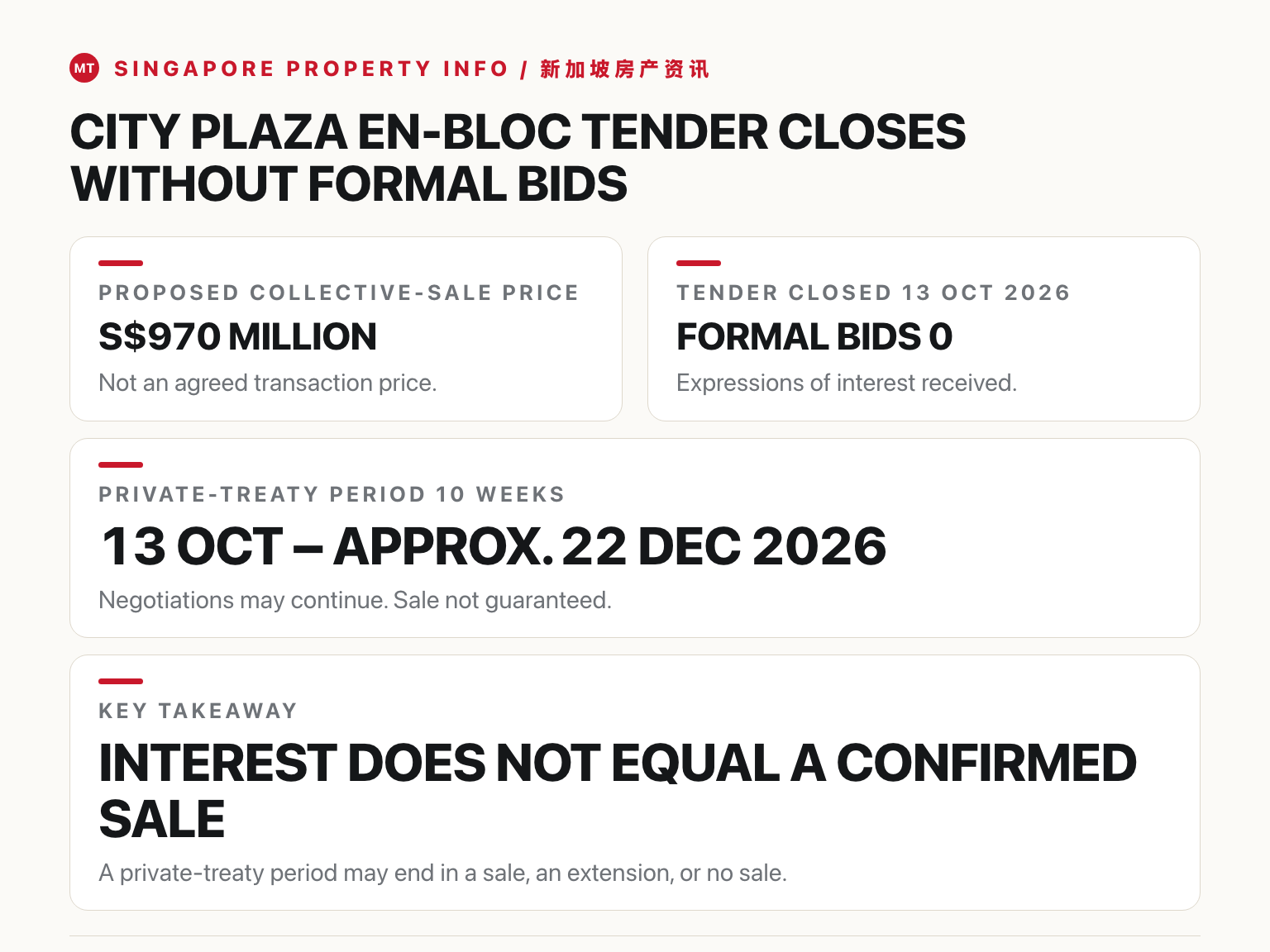
City Plaza’s S$970 million collective-sale attempt has moved into another phase after its public tender closed without a formal bid on 13 October 2026.
According to Business Times, marketing agent Huttons Asia confirmed that expressions of interest had been received and discussions with interested parties would continue during a ten-week private-treaty period.
For owners hoping to sell their development collectively, the distinction matters. Interest in a property does not necessarily mean a buyer is prepared to commit to the proposed price.
No formal bids, but negotiations are continuing
City Plaza is a freehold development near Paya Lebar MRT station. Its collective-sale exercise carried a proposed price of S$970 million.
The tender’s closure without a formal bid means that no purchaser submitted a qualifying bid through the formal tender process.
However, expressions of interest were received, according to Huttons Asia as reported by Business Times.
These expressions indicate that prospective purchasers remain interested in exploring the acquisition, although they do not establish that a sale has been agreed.
The S$970 million figure remains the proposed sale price. It should not be interpreted as an agreed transaction value or evidence of what a purchaser is willing to pay.
What happens during the private-treaty period?
Following the tender’s closure, discussions can continue through a ten-week private-treaty period.
During this stage, the owners’ representatives may negotiate directly with interested parties outside the formal tender process.
Prospective purchasers can use this period to evaluate the development’s potential, clarify commercial terms and decide whether to proceed with an offer.
Based on the reported tender closing date of 13 October 2026, the ten-week period would extend to approximately 22 December 2026.
That date is an indicative calculation rather than a separately verified contractual deadline.
The outcome remains uncertain. Negotiations could lead to an agreement, but the existence of a private-treaty window does not guarantee a sale.
Why interest does not always translate into a bid
A collective-sale site can attract attention without receiving an acceptable formal offer.
Prospective purchasers must assess whether the proposed acquisition price and redevelopment potential justify the total investment required.
Their considerations may include planning requirements, construction costs, financing conditions and expectations for the completed development.
These are general commercial considerations, not established reasons for City Plaza’s unsuccessful tender.
The available reporting does not identify why interested parties chose not to submit formal bids.
For owners, this illustrates an important distinction: securing sufficient support to launch a collective-sale exercise does not guarantee that a purchaser will accept the proposed price.
What City Plaza owners should consider now
The immediate question is whether discussions during the private-treaty period can produce an offer acceptable under the collective-sale process.
Until an agreement is reached, owners should avoid treating expressions of interest as a confirmed sale.
Those making housing or financial plans may need to consider how continued uncertainty affects their individual circumstances.
For example, an owner planning to purchase a replacement home should distinguish between an anticipated collective-sale payout and proceeds from a transaction that has actually been agreed and completed.
Owners renting out their units may also need to consider existing tenancy commitments when planning for a possible future sale.
Similarly, major maintenance decisions should be assessed against the development’s current position rather than an assumed completion date.
These considerations differ between owners. A collective sale may eventually proceed, but the timing and outcome should not be treated as certain while negotiations remain unresolved.
What the City Plaza outcome tells us
City Plaza’s tender result does not establish that its collective-sale exercise has failed permanently.
The absence of formal bids is a setback for the proposed transaction, but expressions of interest leave room for further negotiations.
The next meaningful development will be whether those discussions produce an offer that can progress through the required collective-sale process.
For owners considering an en-bloc exercise elsewhere, the broader lesson is that an asking price, buyer interest and an agreed sale are three different stages.
Property decisions should be based on the stage the transaction has actually reached, rather than the outcome owners hope it will achieve.
References
The article’s factual account is based primarily on this reported statement from the marketing agent. General discussion of buyer considerations is kept clearly separate from confirmed facts about City Plaza.