Quick answer
From 29 July 2026, qualifying large en bloc redevelopment sites with 700 to 1,399 residential units after redevelopment may have a 6-year completion and sale timeline. Qualifying mega sites with at least 1,400 residential units may have a 7-year completion and sale timeline, but must sell at least 50% of units by the end of year 6. The change is targeted and does not apply to every developer or every en bloc project.
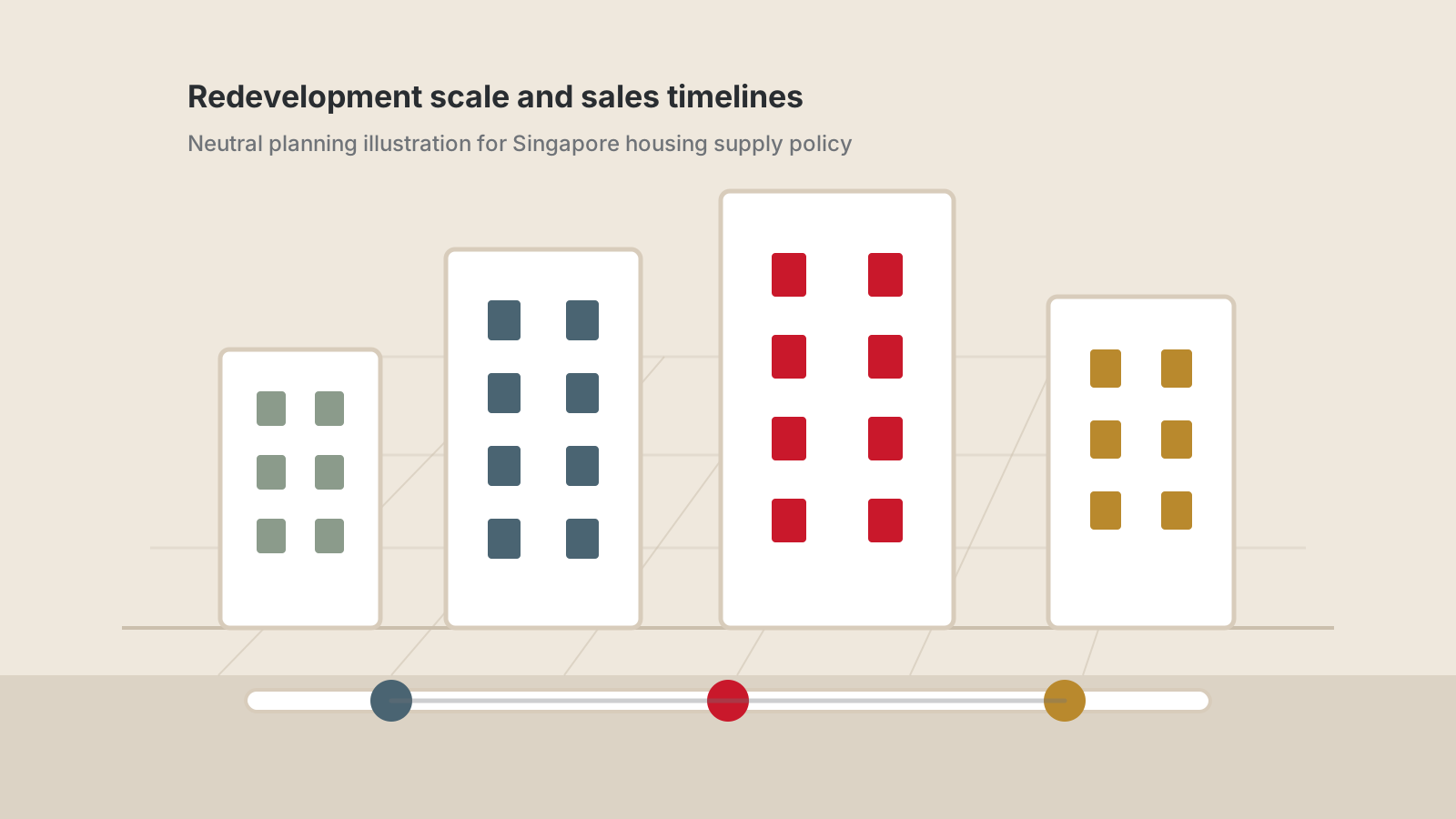
The Ministry of Finance and Ministry of National Development announced revisions to the Additional Buyer’s Stamp Duty regime for licensed housing developers undertaking qualifying large-scale en bloc redevelopments. The announcement is technical, but the practical point is clear: some very large redevelopment projects may receive more time to complete and sell all residential units, subject to official conditions.
This matters because large en bloc sites can take longer to plan, coordinate, build and sell than smaller residential projects. The revised framework is not a broad market signal that every redevelopment site receives longer timelines. It is a specific adjustment for qualifying sites purchased on or after 29 July 2026.
What the Government announced
The revised framework creates two groups within Category 1 en bloc projects. Category 1A covers large sites that can yield at least 700 but fewer than 1,400 residential units after redevelopment. Their completion and sale timeline increases from 5.5 years to 6 years.
Category 1B covers mega sites that can yield at least 1,400 residential units after redevelopment. Their completion and sale timeline increases from 5.5 years to 7 years. Mega-site developers must also sell at least 50% of the residential units by the end of year 6. If they fail that intermediate sales condition, the full clawback on the 35% upfront remittable ABSD component with interest can apply at the end of year 6.
How developer ABSD timelines work
Licensed housing developers purchasing residential land are subject to developer ABSD. The official announcement states that this comprises a 5% non-remittable component and a 35% upfront remittable component. The remittable component, with interest, can be clawed back if the required commencement, completion and sale timelines are not met.
For regular en bloc sites yielding 5 to 699 residential units, the framework remains unchanged: a 2-year commencement timeline and a 5-year completion and sale timeline. The revised 2026 changes are aimed at larger qualifying en bloc redevelopments that meet additional requirements.
Which en bloc sites qualify?
The revised timelines apply only to qualifying en bloc sites purchased on or after 29 July 2026. To qualify as a Category 1A or Category 1B site, the redevelopment must yield at least 1.5 times the number of residential units in the existing development.
The commencement timeline for Category 1A and Category 1B remains 2.5 years. If a large or mega site qualifies under more than one category of the Complex Projects framework, an additional 6-month extension may apply, subject to the official requirements. Even with that extra extension, mega sites must still sell at least 50% of residential units by the end of year 6.
Comparison of en bloc redevelopment timelines
| Site category | Redevelopment unit count | Minimum intensification | Commencement timeline | Completion and sale timeline | Intermediate sales condition |
|---|---|---|---|---|---|
| Regular en bloc site | 5 to 699 residential units | Not applicable | 2 years | 5 years | None under this category |
| Category 1A large site | 700 to 1,399 residential units | At least 1.5 times the existing unit count | 2.5 years | 6 years | None under this category |
| Category 1B mega site | At least 1,400 residential units | At least 1.5 times the existing unit count | 2.5 years | 7 years | At least 50% of units sold by the end of year 6 |
Why larger redevelopment projects may need more time
A very large en bloc redevelopment can involve more design, infrastructure, phasing, authority coordination, construction staging and sales planning than a smaller project. A site that eventually delivers hundreds or more than a thousand homes may also need deeper coordination around traffic, utilities, estate interface and construction sequencing.
The sales side can also be different. A larger project may need to reach a wider group of buyers across unit types, budgets and move-in timelines. More time does not make demand automatic, but it may allow the launch, construction and sales programme to be managed over a more suitable runway for projects of that scale.
Longer timelines may therefore help some qualifying projects move from acquisition to completed housing supply in a more realistic way. However, the extension does not remove the developer’s obligations. It changes the timeline only for sites that satisfy the official framework.
What this may mean for ageing developments
For older residential developments, the change may make some large-scale redevelopment proposals easier for developers to assess. A longer sale timeline can be relevant where the potential new project is unusually large and would need a broader sales period.
Owners should not assume that this makes an en bloc sale likely, suitable or financially favourable. Collective sales still depend on many factors, including owner consent, reserve price, planning considerations, market conditions, developer appetite and project feasibility.
What this may mean for future housing supply
The policy is framed around supporting redevelopment and future housing supply. If qualifying sites proceed, they could add new homes over time, especially where redevelopment produces significantly more units than the existing development.
That said, the effect may vary by project and by market cycle. The announcement should not be treated as a price forecast for private homes, new launches or older condominiums. Buyers should continue to review location, pricing, supply pipeline, affordability and project fundamentals.
What homebuyers should understand
For buyers, the main takeaway is not that every new launch will have more time to sell. The revised timeline is tied to qualifying large and mega en bloc redevelopments. Smaller projects and sites outside the qualifying conditions may still follow different timelines.
Buyers comparing future supply may want to watch whether large redevelopment sites become part of the new launch pipeline. A longer developer timeline may affect when a project is launched, how sales are phased and how supply appears in the market, but it does not determine whether a unit is suitable for a particular household.
What existing owners should not assume
Existing owners in ageing developments should be careful not to read the announcement as a prompt to support or expect a collective sale. The policy does not say that a specific site will transact, that developer demand will improve for every estate, or that owners will receive a particular outcome.
Any collective sale discussion should be reviewed through the actual development, planning context, owner profile, legal process, timeline, replacement-home needs and prevailing market conditions. This article is general education, not legal, financial, tax or investment advice.
FAQ
Final thoughts
The 2026 ABSD timeline revision is best read as a targeted policy adjustment for very large qualifying redevelopment sites. It gives some projects a longer runway, while keeping commencement duties, completion duties, sales duties and the mega-site 50% year-6 condition in place.
For owners and buyers, the practical approach is to treat the announcement as one part of the wider supply picture. It may influence how large redevelopment projects are assessed, but individual property decisions should still be based on verified facts, affordability, timeline and current official requirements.
Sources referred to
- MOF and MND joint announcement on ABSD revisions for large-scale en bloc redevelopments
- MND announcement on the ABSD(HD) Remission Timeline Extension Framework for Complex Projects
Accuracy note: This article is based on official MOF and MND announcements available on 28 July 2026 and is for general educational discussion. It is not legal, financial, tax or investment advice. Readers should verify the latest official requirements and seek professional advice where needed.