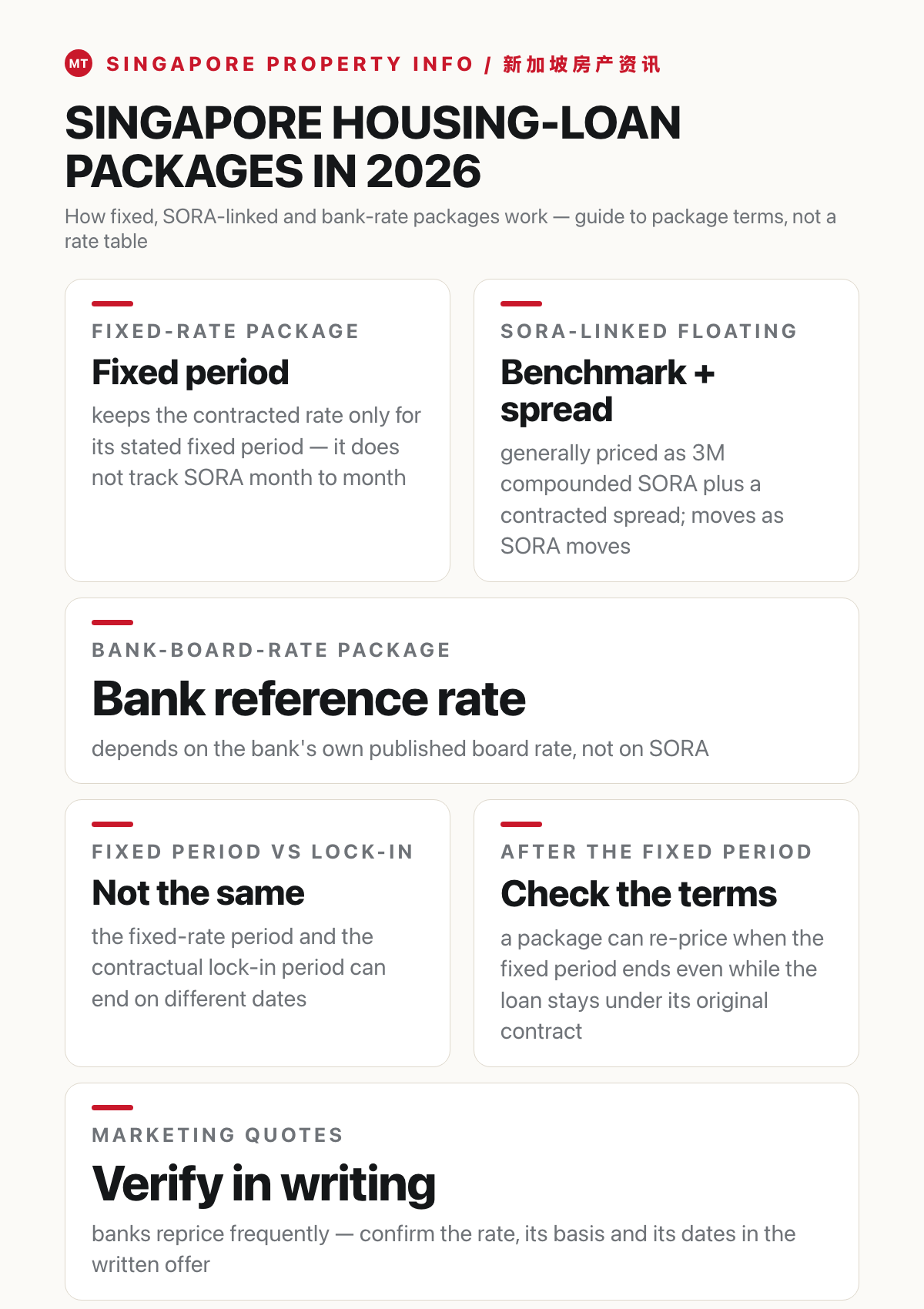
What the three common package types actually mean
Most housing-loan packages in Singapore fall into three families, and each works differently. A fixed-rate package keeps the contracted interest rate for its stated fixed period — the rate does not track the benchmark month to month. A SORA-linked floating package generally prices as the benchmark plus a contracted spread, so its rate moves as 3-month compounded SORA moves. A bank-board-rate package depends on the bank’s applicable published reference rate, and it moves only if the bank changes its board rate. None of these mechanisms mean rates follow US Fed decisions one-for-one — local bank pricing sits with each bank’s funding costs and risk view, not with any single external rate decision.
Because banks reprice their offers, any rate quoted in marketing material can already have moved by the time a sale completes. Verify the rate, its basis and its dates in the written offer before relying on any figure.
The 5-year fixed package for HDB flat owners
Some banks have offered a five-year fixed-rate package to HDB flat buyers. The key point for an HDB buyer is unchanged: the fixed-rate period on such a package is not necessarily the contractual lock-in period, so check which one the offer actually guarantees. A rate quoted early in the year may already be gone from bank shelves by the time the sale completes — which is the point of checking terms, not just the rate, before signing.
Why longer fixed-rate periods are not automatically safer
When the gap between a 2-year and a 3-year fixed quote widens, the extra years of certainty can start looking expensive to borrowers who price each repricing window on its own merits — and cheaper to borrowers who value rate certainty over exposure to repricing. Neither outcome is established by any single statistic: what matters is reading what the offer guarantees and for how long, and what applies between the end of the fixed period and the end of the loan.
What the benchmark rate actually means
Two clarifications routinely get missed in client conversations. First, the relevant floating benchmark in Singapore is 3-month compounded SORA — published daily by the Monetary Authority of Singapore as part of the risk-free-rate reform, and unrelated to any single bank’s own funding costs. Second, “fixed” only fixes the contracted rate during its stated period: a package can re-price when the fixed period ends even while the loan remains under its original contract terms, and only a “fixed for the full loan term” clause (rare) guarantees otherwise.
With lock-ins of two to five years, the terms attached to the package usually decide more of the total cost than the quoted rate does.
Six package terms to check before signing
Before signing a housing-loan offer, check these six terms:
- Whether the package includes a free rate-conversion option, when it can be exercised, and whether fees apply.
- Whether partial prepayment is penalty-free, or whether early repayment of part of the loan triggers a charge.
- Whether a sale or transfer during the lock-in period is waived — HDB buyers whose sale completes mid-lock-in need this answered in writing.
- What the rate is pegged to — a benchmark like 3M SORA plus a spread, or a bank-set rate that can move with the bank’s own funding costs.
- Whether the fixed-rate period and the contractual lock-in period end together — a package can re-price when the fixed period ends while the lock-in runs longer, so check what applies between the two dates.
- Eligibility conditions and clawbacks — cashback or lower-rate offers conditional on taking insurance or investment products, and what is given back if the bundle changes.
For owners still sitting on a package quoted earlier in the year, the repricing question is the same one the existing repricing/refinancing guide covers: switching costs and portability rules can matter more than the headline difference. The point of the checklist is not to hunt the lowest quote; it is to know which six things in the offer actually cost money.
Sources and further reading
Sources:
MAS, “Interest rates and market data” reference-data pages (3M compounded SORA publication) and Singapore risk-free rate reform communication: https://www.mas.gov.sg/interest-rates–market-data/market-interest-rates
Further reading on this site: the Home Loan Repricing or Refinancing guide (published 27 September 2026) for the switching mechanics, and the HDB Loan vs Bank Loan comparison (also 27 September 2026) for the wider financing choice this article presupposes.