Quick answer
Eligible HDB buyers may be able to finance their flat with an HDB housing loan or a loan from a financial institution. The choice affects interest-rate certainty, the cash and CPF needed upfront, repayment flexibility and the options available if the household later wants to change lenders.
CPF Board confirmed on 22 September 2026 that the CPF Ordinary Account interest rate will remain at 2.5% per annum from 1 October to 31 December 2026. Correspondingly, the HDB concessionary housing-loan rate will remain unchanged at 2.6% per annum for the same quarter.
There is no single better loan for every buyer. Compare the confirmed terms, available cash and CPF, household cash flow, risk tolerance and likely holding period before committing.
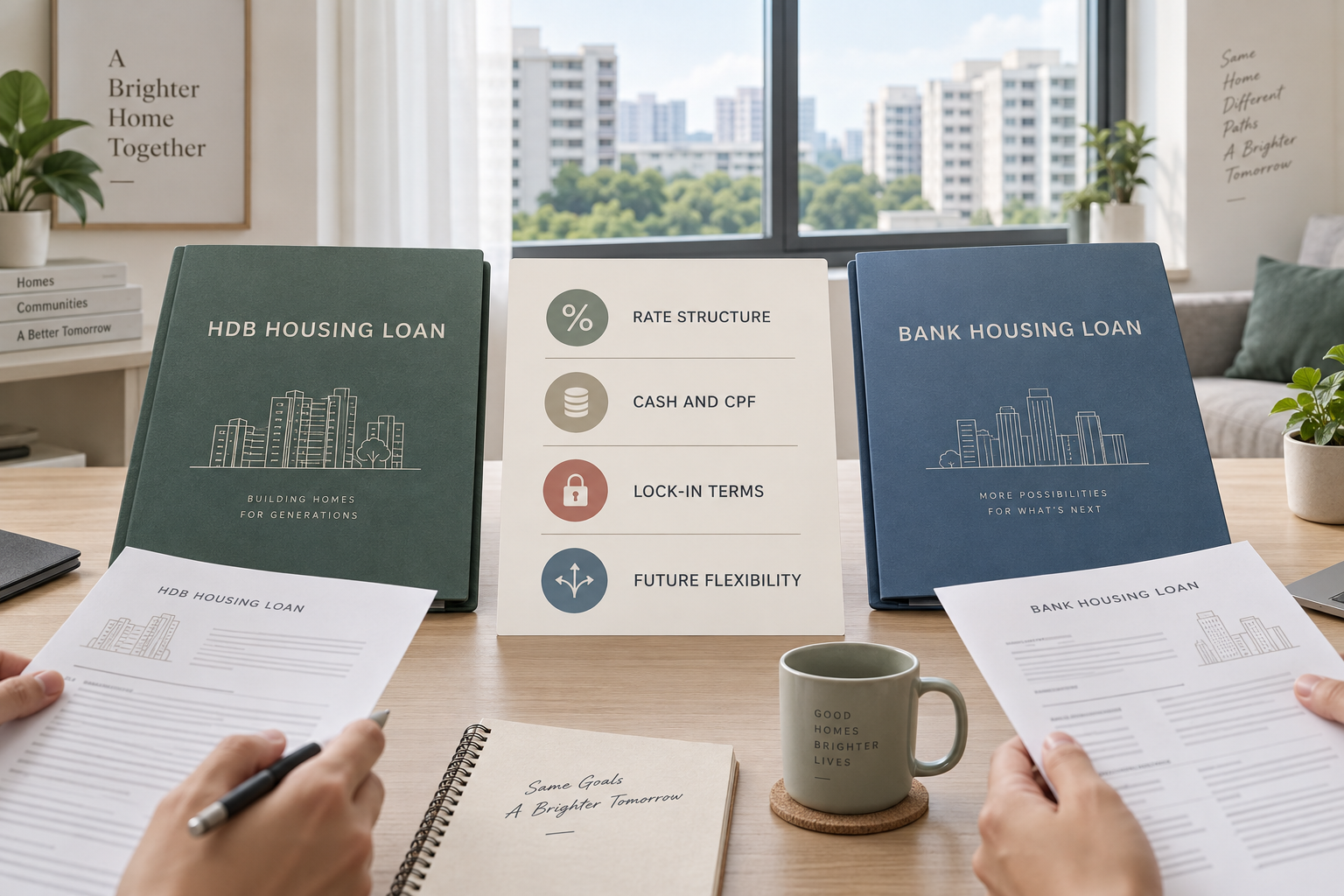
The two financing paths at a glance
Available only to eligible HDB-flat buyers and subject to HDB’s assessment.
Subject to the financial institution’s assessment, package terms and prevailing rates.
Practical comparison
| Factor | HDB housing loan | Bank housing loan |
|---|---|---|
| Rate structure | Concessionary rate linked to the CPF Ordinary Account rate and reviewed quarterly | Fixed or floating packages with lender-specific reset terms |
| Standard first-loan example | Up to 75%, subject to eligibility and assessment | Up to 75%, subject to eligibility and assessment |
| Upfront cash | Standard downpayment may use eligible CPF OA savings, cash or both | CPF Board states that at least 5% of the purchase price is payable in cash in the standard example |
| Lock-in and early repayment | No lock-in period or early-repayment penalty | Package may include a lock-in period and repayment or redemption charges |
| Future switching | May later move to a bank, subject to approval | Cannot later change the flat’s bank loan to an HDB housing loan |
This is a general comparison based on current official guidance. The applicable loan limit, cash requirement and terms depend on the buyer, flat and lender assessment.
Key takeaways
- The HDB concessionary housing-loan rate remains 2.6% per annum from 1 October to 31 December 2026.
- The rate is pegged at 0.1 percentage point above the CPF Ordinary Account rate, which remains 2.5% for 4Q 2026.
- An HDB housing loan is available only to eligible HDB-flat buyers and remains subject to HDB’s assessment.
- CPF Board’s current comparison states that an HDB-loan downpayment may use eligible CPF Ordinary Account savings, cash or both. A standard bank-loan purchase requires at least 5% of the purchase price in cash.
- Bank loans may use fixed or floating rates and can include package conditions, lock-in periods and early-repayment charges.
- An eligible HDB borrower may later refinance to a bank, subject to approval. A bank loan for an HDB flat cannot later be changed to an HDB housing loan.
- A maximum approved loan is not automatically a comfortable household budget.
Background
The financing decision should begin before a buyer commits to a flat. HDB assesses eligibility for an HDB housing loan through the HDB Flat Eligibility letter process. A buyer considering bank financing can request an In-Principle Approval from a participating financial institution and later obtain a Letter of Offer for the selected purchase.
These documents have different functions. The HFE letter records HDB’s assessment, an IPA is an indicative bank-loan assessment, and a Letter of Offer contains the bank’s confirmed terms. The HFE, IPA and Letter of Offer timeline explains when each document is needed.
Loan approval and purchase affordability are also different questions. A household should test the instalment against recurring expenses, renovation, insurance, family commitments and an emergency reserve rather than treating the maximum loan amount as a spending target.
Latest update
CPF Board’s release dated 22 September 2026 confirms the interest rates applying from 1 October to 31 December 2026:
- CPF Ordinary Account: 2.5% per annum;
- CPF Special, MediSave and Retirement Accounts: 4% per annum; and
- HDB concessionary housing loan: 2.6% per annum.
The HDB rate remains 0.1 percentage point above the CPF Ordinary Account rate. CPF Board states that the computed Ordinary Account peg remained below the legislated 2.5% minimum for the quarter, so the OA rate and corresponding HDB rate remain unchanged.
The announcement does not change HDB-loan eligibility, loan assessment, downpayment rules or the terms offered by banks. It also does not mean that bank mortgage rates will remain unchanged. Bank packages may be fixed or floating and depend on each lender’s pricing, benchmark, margins and package conditions.
Buyers should therefore use 2.6% as the confirmed HDB reference for 4Q 2026 while comparing it with an actual bank Letter of Offer. Advertised rates alone are not enough; review the effective interest rate, reset formula, lock-in period, fees and later package terms.
Who is affected
- Buyers of new or resale HDB flats who may qualify for an HDB housing loan.
- Buyers deciding how much cash and CPF to use for their downpayment.
- Households choosing between repayment stability and exposure to changing bank rates.
- Buyers who may make partial repayments or sell within a bank package’s lock-in period.
- Existing homeowners selling one flat and financing their next HDB purchase.
Who is not affected
Private-property purchases cannot be financed with an HDB housing loan. Those buyers require bank or other eligible financing.
The confirmed 2.6% rate also does not establish that every HDB buyer qualifies for an HDB loan or for the same loan amount. HDB and each financial institution apply their relevant eligibility and credit assessments. Buyers with an existing housing loan, a longer proposed tenure or other financial commitments may face different loan limits or upfront requirements.
What remains unchanged
Regardless of lender, buyers should still:
- obtain a valid HFE letter at the applicable HDB purchase checkpoints;
- secure the appropriate bank IPA and Letter of Offer when using financial-institution financing;
- confirm the purchase price, valuation basis, approved loan and downpayment;
- check CPF usage and remaining-lease requirements;
- budget for duties, legal costs, renovation, insurance and moving expenses;
- understand the applicable Mortgage Servicing Ratio, Total Debt Servicing Ratio and loan-to-value requirements;
- review Home Protection Scheme requirements where relevant; and
- keep the purchase within a comfortable household budget.
A loan approval does not guarantee the property’s value or future market performance.
Planning considerations
Compare the full loan structure
The HDB concessionary rate provides a clear reference because it is linked to the CPF Ordinary Account rate. A bank’s quoted rate may be lower or higher at a given time, but the comparison should include the effective interest rate, what happens after any fixed period, and the possible repayment under reasonable rate scenarios.
Ask the bank to explain its property loan fact sheet, benchmark, margin, reset dates, lock-in period and penalty provisions.
Plan the cash and CPF downpayment
CPF Board states that the standard HDB-loan downpayment may be funded with eligible CPF Ordinary Account savings, cash or both. For a standard bank-loan purchase, 5% of the purchase price is payable in cash, with the remaining downpayment funded through cash, CPF or both, subject to applicable requirements.
For a resale flat, any amount above valuation must generally be funded in cash. Keep a separate reserve for legal costs, renovation, moving and unexpected expenses.
Decide how much CPF to retain
CPF Board explains that a buyer using an HDB housing loan may retain up to S$20,000 in the Ordinary Account, subject to applicable requirements. A bank-loan borrower can decide how much eligible OA savings to use.
Using more CPF may reduce immediate cash strain, but CPF also supports retirement. Consider the longer-term effect rather than focusing only on the purchase date.
Review flexibility and switching limits
HDB housing loans do not have a lock-in period or an early-repayment penalty. Bank packages commonly have lock-in periods during which partial repayment, redemption or refinancing may trigger charges.
An eligible HDB borrower may later refinance to a bank, subject to the bank’s approval. Once the flat’s financing has moved to a bank, it cannot be changed back to an HDB housing loan. The repricing and refinancing guide explains that later-stage decision.
Stress-test the household budget
Model the instalment using a higher interest rate, not only the initial quoted rate. Include other debts, household expenses, possible income changes and a cash reserve.
The TDSR and property affordability guide provides a broader framework. Buyers should use their confirmed HFE and lender documents for the actual transaction.
FAQ
Official sources
- CPF Board — Government extends 4% interest rate floor on Special, MediSave and Retirement Account monies until 31 December 2027 — 22 September 2026
- CPF Board — How are CPF interest rates determined? — current 4Q 2026 computation
- CPF Board — HDB loan or bank loan? Three differences you should know — 12 June 2026
- HDB — Housing Loan from HDB
- HDB — Housing Loan from Financial Institutions
- MoneySense — How home loans work — updated 1 July 2026
This article provides general educational information. Loan eligibility, approval, pricing and terms depend on the buyer, flat, lender and prevailing requirements. Confirm current HDB, CPF and lender documents before committing.