Quick answer
Cash over valuation, commonly called COV, may arise when the agreed resale price of an HDB flat is higher than the value established through HDB’s Request for Value process. The difference can create an additional cash requirement even when the buyer has an HFE letter or a sizeable indicative loan amount.
For buyers using CPF savings or a housing loan, the Request for Value comes after the seller grants the Option to Purchase. Buyers should therefore compare relevant transactions and stress-test their available cash before agreeing on the price, rather than waiting for the valuation outcome to consider affordability.
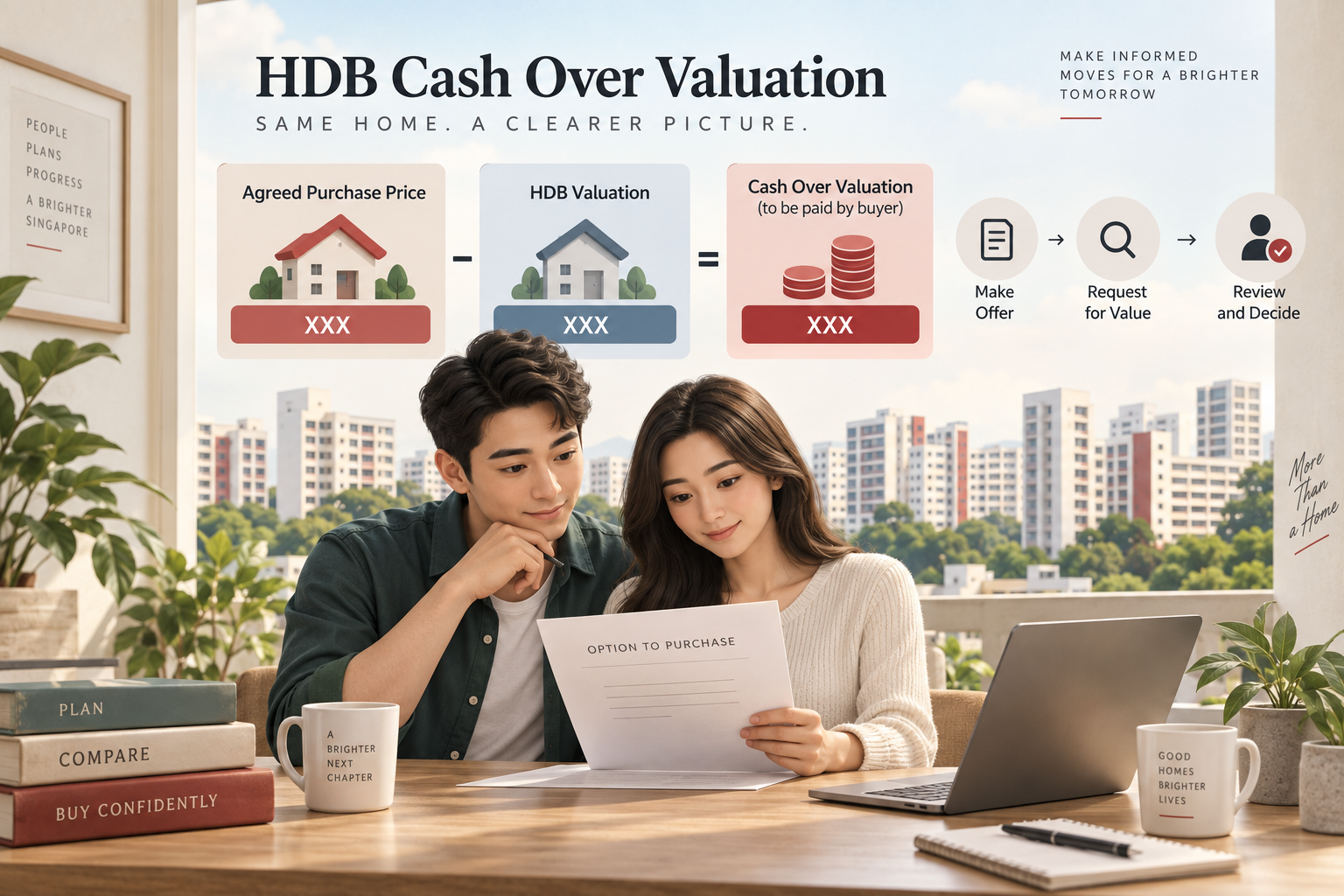
How the cash difference can arise
The price negotiated by buyer and seller before the Request for Value.
−
The value used as the basis for CPF usage and/or the housing-loan reference.
=
If the agreed price is higher, the difference may need to be funded in cash.
This is a planning illustration, not a valuation. The actual outcome depends on the specific flat and transaction.
Key takeaways
- The agreed resale price is negotiated before the buyer submits a Request for Value.
- A buyer using CPF savings or a housing loan must generally submit the request by the next working day after the Option Date.
- HDB states that the Request for Value determines the value used as the basis for CPF usage and/or as the reference for the housing loan, unless the financial institution advises otherwise.
- The processing fee is S$120, and the outcome is typically available within 10 working days.
- Buyers must wait for the outcome before exercising the OTP.
- If the agreed price is above the value, the difference may create a cash-over-valuation amount that the buyer should be ready to fund in cash.
- A high asking price, listing price or exceptional transaction is not automatically the value of another flat.
Background
COV is not an extra fee charged by HDB. It describes the positive difference between the agreed resale price and the value used for the transaction.
For example, if a buyer agrees to pay S$800,000 and the Request for Value outcome is S$760,000, the difference is S$40,000. This simple illustration does not predict the valuation of any actual flat.
The timing matters. HDB’s process places the Request for Value after the seller grants the OTP. Buyers therefore cannot treat an official value as a pre-offer price guide. HDB instead provides recent registered resale transactions that buyers and sellers can use when negotiating.
Latest context
Public discussion on 25 September 2026 about a combined Telok Blangah flat listed at a high asking price prompted HDB to say that it was reviewing its Conversion Scheme. HDB’s attributed comments also highlighted the gap that may arise when an asking price is significantly above comparable transactions.
This was not a completed policy change. No amended Conversion Scheme rule or effective date was announced. Buyers should not infer that combined flats, jumbo flats or ordinary resale flats are now subject to new requirements.
The practical reminder applies more broadly: an asking price is not an HDB valuation, and an unusual property still requires evidence-based price and cash planning.
Who is affected
Buyers using CPF savings or a housing loan
HDB states that these buyers must submit a Request for Value after receiving the OTP. The outcome forms the basis for CPF usage and/or the reference for the housing loan amount, unless a financial institution advises otherwise.
Buyers considering an unusual or premium-priced flat
Direct comparables may be limited for converted, jumbo, highly renovated or otherwise uncommon flats. A buyer should widen the evidence carefully without assuming that every attractive feature will be fully reflected in the valuation.
Sellers setting an asking price
Sellers do not use the Request for Value as a marketing valuation. HDB says buyers and sellers can review recent registered resale prices to support negotiations. Pricing far beyond relevant evidence may narrow the buyer pool or create a cash gap after the OTP is granted.
Who is not affected
A buyer paying entirely in cash, without CPF savings or a housing loan, does not need to submit a Request for Value under HDB’s current guidance.
This guide does not cover private residential property valuations, bank valuations for private property, BTO pricing or the value of a specific flat. It also does not predict the outcome of HDB’s Conversion Scheme review.
What remains unchanged
- Buyers should have a valid HFE letter at the applicable purchase checkpoints.
- The HDB-prescribed OTP remains the contract used for an HDB resale transaction.
- The Option Period is 21 calendar days, including weekends and public holidays.
- A buyer using CPF or financing should submit the Request for Value by the next working day after the Option Date.
- The buyer must wait for the outcome before exercising the OTP.
- The Request for Value outcome is generally valid for three months, during which both parties must submit their portions of the resale application.
- Eligibility, financing, CPF usage, remaining lease and other transaction requirements still depend on the household and flat.
Planning considerations
Compare the most relevant transactions before agreeing on price
Start with the same block and flat type where possible. Then review floor area, storey band, remaining lease, location within the estate and registration date. The HDB resale market guide explains why a broad market index is context rather than a valuation for one flat.
Renovation, orientation, view and condition may affect buyer interest, but public transaction data may not disclose those details. Do not attach an assumed premium without evidence.
Separate total affordability from loan eligibility
An HFE letter, bank IPA or Letter of Offer answers important financing questions, but it does not guarantee that the full agreed price will be covered. Review the HFE, IPA and Letter of Offer timeline and the HDB loan or bank loan guide before committing.
Keep separate cash allowances for a possible amount above value, the deposit, legal expenses, renovation, moving and an emergency reserve.
Use the Option Period carefully
HDB’s current process gives the buyer a 21-calendar-day Option Period. Submit the Request for Value promptly, monitor My Flat Dashboard and wait for the outcome before deciding whether to exercise the OTP.
The Option Fee is not risk-free money. Buyers should read the OTP and current HDB terms, understand the consequences of allowing it to expire and seek professional advice if uncertain about their contractual position.
Treat record transactions as exceptional evidence
A record price can be relevant, but it should not become the only comparable. The Pinnacle@Duxton record-price analysis explains why one unusual sale does not establish the value of every flat in the same development or town.
Review the complete household plan
Price is only one part of suitability. Check monthly repayment comfort, CPF use, remaining lease, renovation needs, expected holding period and whether the flat still suits the household if circumstances change.
FAQ
Official sources
This article provides general educational information. It is not a valuation, financing approval or guarantee of a transaction outcome. Confirm current HDB, CPF and lender requirements for the specific flat and household before committing.