By Melvin Tan Property
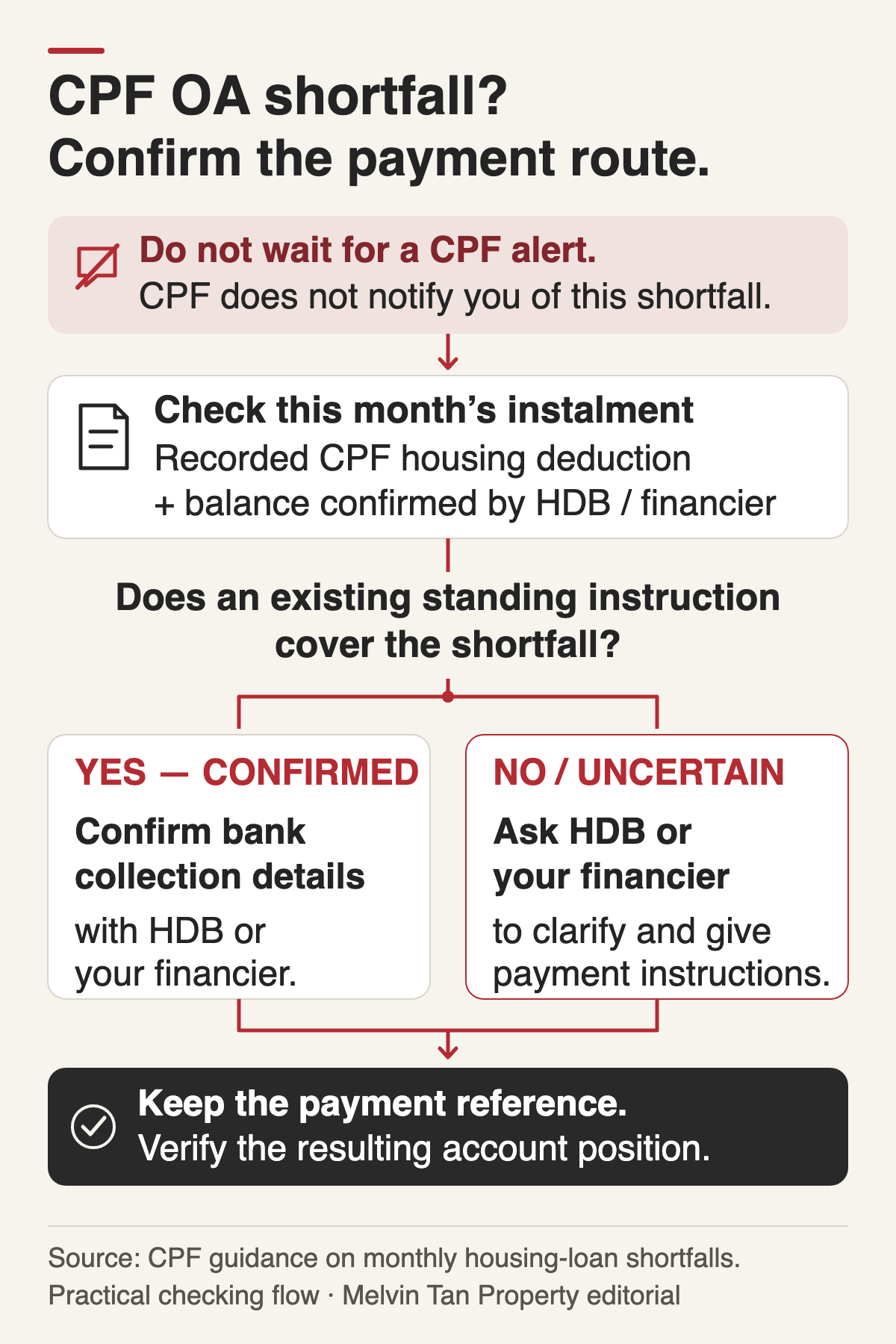
CPF says you will not be informed if you have insufficient CPF savings for your monthly housing-loan deduction. You need to settle the outstanding instalment directly with HDB or your financier, unless you already have a standing instruction with them to cover the shortfall from your bank account.
That distinction matters when you use Ordinary Account (OA) savings for your mortgage. Having money in a bank account and having an arrangement that actually collects a mortgage shortfall are separate things.
Summary
Use the steps below to reconcile this month’s CPF deduction with the lender’s outstanding balance, then keep the payment details together for future checks.
What CPF’s answer means for this month’s instalment
The CPF explanation on insufficient savings for a monthly housing-loan deduction addresses a specific event: insufficient CPF savings for that monthly deduction. It does not establish a universal notification rule for every mortgage event or every message your lender might send.
This is a servicing issue rather than a comparison of mortgage packages. If you are reviewing the broader choice of lender for an HDB flat, the guide to comparing an HDB loan with a bank loan provides separate context. For a current unpaid instalment, start with the organisation receiving your mortgage payment.
Check the deduction, the balance and the payment arrangement
Use these practical checking steps to review this month’s payment.
1. Look at the recorded CPF housing deduction
CPF’s answer directs members to their Transaction History statement to monitor deductions. The statement provides a breakdown of contributions and withdrawals, including housing-loan deductions.
Use the recorded housing deduction as evidence of what was deducted. Avoid treating an expected deduction, an anticipated contribution or a previous month’s successful payment as confirmation of this month’s position. If the record is unclear, identify the transaction and month you want clarified before contacting CPF or the lender, as appropriate to the question.
2. Ask HDB or the financier what remains outstanding
Confirm the instalment being checked and the amount still unpaid. If you have already made a separate cash payment, provide its reference so the lender can explain how it has been reflected in your account.
This matters because a shortfall calculation is only useful when its inputs match the same instalment. A household’s own spreadsheet can help organise information, but the actual outstanding payment should be confirmed with HDB or the financier. Do not substitute an estimate for their account position when arranging settlement.
3. Establish whether the bank arrangement covers a shortfall
Ask specifically whether there is an existing standing instruction that covers a shortfall in the CPF housing payment. A general recollection that you previously supplied bank details does not establish the scope or current status of that arrangement.
Useful questions include which bank account is linked, whether the arrangement covers the outstanding amount in question, and how to confirm that payment has completed. These are questions to resolve with the actual lender or HDB; this article does not supply a universal debit date or collection process.
4. Obtain payment instructions when direct settlement is needed
If no existing instruction covers the shortfall, ask HDB or the financier for the applicable direct-payment method and reference details. If the arrangement’s status is uncertain, resolve that uncertainty with them before assuming a bank debit will occur.
Keep the payment reference and check the resulting account position. This record is a practical follow-through step, not a statement that every payment method has the same processing time or that a submitted payment is immediately reflected.
Worked example: distinguish the cash gap from a collection mandate
Consider an illustrative monthly instalment of $2,000, with $1,500 recorded as the CPF housing deduction for that instalment. Assume there are no other payments or account adjustments in this simplified example.
| Item | Illustrative amount |
|---|---|
| Monthly instalment | $2,000 |
| Recorded CPF housing deduction | $1,500 |
| Difference to reconcile with the lender | $500 |
The $500 difference is arithmetic, not a published CPF threshold. It tells the borrower what to ask about; it does not establish how the lender will collect it.
Make the monthly review easy to repeat
A small payment record can make future checks more useful. As practical household administration, keep the instalment month, amount due, recorded CPF deduction, any separate cash payment and its reference, and the lender-confirmed outstanding balance together. Record the status of the standing instruction separately from individual payments.
Choose a review point that gives you time to raise questions with HDB or your financier. The appropriate timing depends on your own payment arrangement. CPF guidance does not specify a grace period, a retry date, a late-fee rate or an enforcement timetable, so none should be assumed from this article.
If you change how you fund the mortgage, ask the relevant organisation what needs to be done for your account. Do not infer that making a cash payment automatically reinstates or changes future CPF deductions. That future arrangement needs its own confirmation.
Consider the buffer as well as the immediate payment
CPF’s guidance also offers sustainable-payment tips: keep the monthly instalment within monthly OA contributions, consider a mix of cash and OA savings, and retain OA savings equivalent to six months of monthly instalments for emergencies. These are CPF’s planning tips, not a guarantee that a particular household will always have sufficient funds.
For example, applying the six-month suggestion to the illustrative $2,000 instalment gives a $12,000 OA buffer. This is an illustration of the source’s suggestion, not an additional mandatory amount or an eligibility rule.
In practical planning, compare your present OA balance with the way you expect to fund upcoming instalments. A buffer gives the household a clearer view of its resources, while a cash contribution changes how much of the mortgage is being met from OA. CPF also reminds members that these savings are primarily for future retirement needs.
For private-home owners considering that wider balance, the guide to CPF use, cash commitments and retirement planning for private property addresses the broader purchase-planning context. Keep that longer-term review separate from confirming whether a current instalment has actually been settled.
Discuss a sustainable property budget
If checking the mortgage reveals a wider question about what your household can comfortably commit to its next property, you can discuss your property budget with Melvin Tan Property. Bring a clear view of your monthly instalment, OA contribution pattern and intended cash contribution so the discussion starts with your actual circumstances.
For payment instructions, outstanding balances and the status of a collection arrangement, continue to deal directly with HDB or your financier. Property planning advice does not confirm that a mortgage payment has been received.
Official source
CPF: Will I be informed if I do not have enough CPF savings for the monthly housing loan deduction?.