Quick answer
Buying property through a company is not simply the personal-buying process with a different name on the contract. Property classification, stamp duties, GST, ownership requirements, financing terms and the future disposal route can all change the result.
For residential property, current IRAS guidance applies a 65% Additional Buyer’s Stamp Duty rate to entities buying on or after 27 April 2023, based on the higher of the purchase price or market value. Purely commercial and industrial acquisitions follow a different framework, but still require careful checks before an option or purchase agreement is accepted.
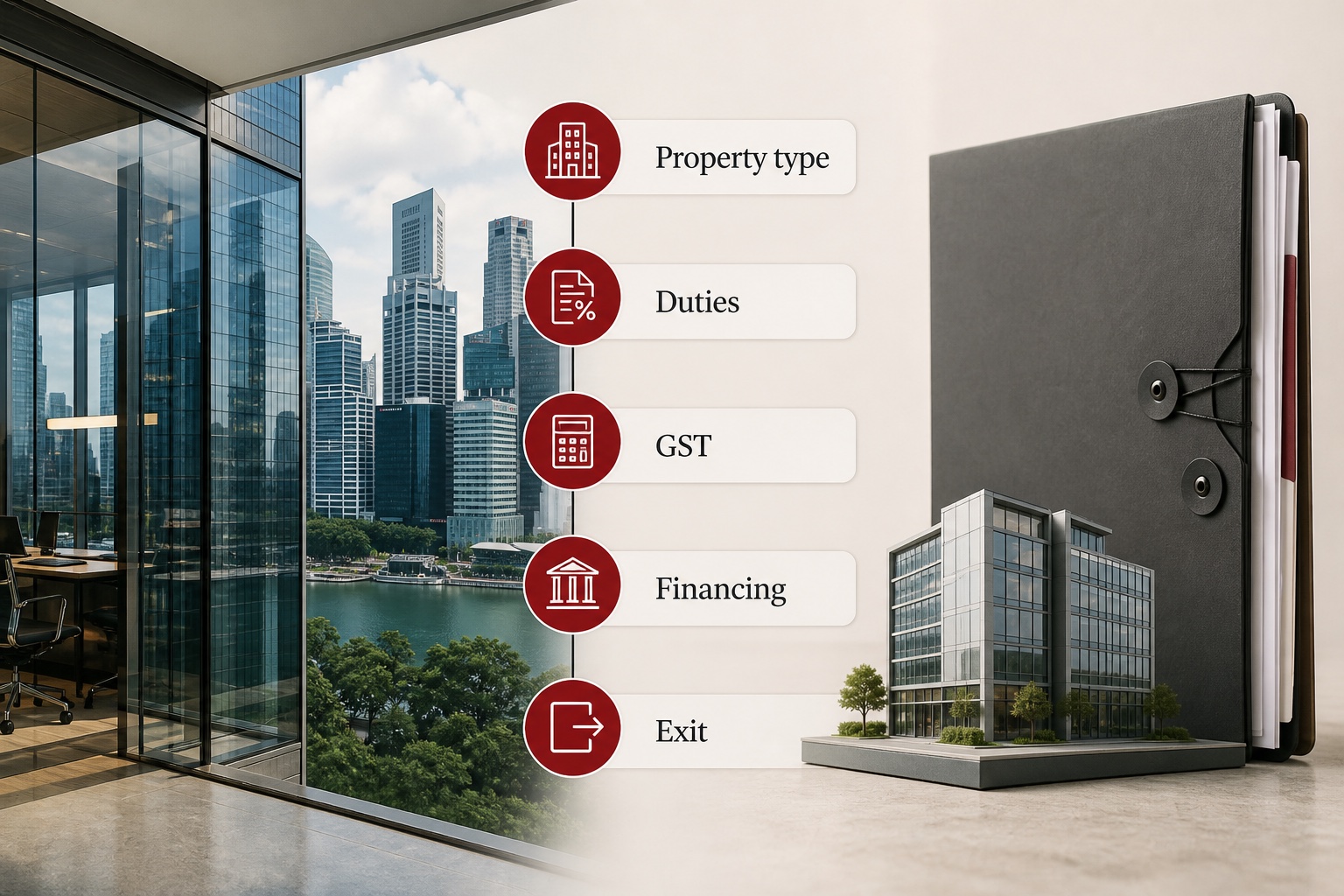
What changes at a glance
| Decision area | Residential property | Non-residential property |
|---|---|---|
| ABSD | IRAS currently applies 65% to entities buying residential property, subject to the published rules. | ABSD applies to residential property, so confirm that the premises are purely non-residential. |
| BSD | Residential marginal bands apply, based on the higher of price or market value. | Non-residential marginal bands apply, based on the higher of price or market value. |
| GST | Check the residential classification and any taxable non-residential or movable components. | GST is payable when the seller is GST-registered; any input-tax claim requires its own review. |
| Ownership | Restricted residential property and the company profile may require additional review. | SLA lists industrial and commercial property among the types a foreign person can buy without Residential Property Act approval. |
| Future exit | A qualifying transfer of shares in a residential property-holding entity may attract Additional Conveyance Duties. | Review the property sale, share sale, GST, financing and corporate consequences before choosing an exit route. |
The table is a decision guide, not a transaction calculation. Mixed-use property, temporary permissions, housing developers, trusts and property-holding entities require specialist advice.
Key takeaways
- Establish whether the property is residential, non-residential or mixed-use under the relevant planning, title and tax rules.
- BSD applies to acquisitions of Singapore property and is generally calculated on the higher of the stated purchase price or market value.
- IRAS currently states that an entity buying residential property on or after 27 April 2023 is subject to 65% ABSD, with separate published treatment for qualifying housing developers.
- GST may form part of a non-residential purchase when the seller is GST-registered. Input tax should never be assumed to be automatically claimable.
- Company financing, guarantees, shareholder arrangements and the intended exit route should be reviewed before commitment.
Background
A company may consider property for its own occupation, investment, rental or operational use. The commercial rationale can differ significantly between a private residential unit, strata office, shop, shophouse, factory and mixed-use property.
The first question is therefore what the property is under the applicable planning, title and tax rules. The second is whether company ownership serves a genuine business purpose after duties, GST, financing conditions, holding costs and future transaction implications are considered.
No single ownership structure suits every buyer. The actual company, shareholders, property and intended use determine which legal, tax, accounting and financing questions matter.
Current official guidance
IRAS states that entities buying residential property on or after 27 April 2023 are subject to ABSD at 65% on the higher of the purchase price or market value. BSD is separately payable on acquisitions of property in Singapore and also uses the higher of the purchase price or market value.
For non-residential property, IRAS states that GST is payable when the seller is GST-registered. Whether a purchasing company can claim input tax depends on the GST rules and its actual circumstances, so it should be reviewed with a qualified adviser rather than treated as an automatic recovery.
SLA lists industrial and commercial property among the property types a foreign person can purchase without approval under the Residential Property Act. Restricted residential property and mixed-use situations still require closer review.
Who is affected
This guide is relevant to business owners considering premises for their operations, companies considering commercial or industrial property for investment or occupation, investors comparing personal and company ownership, and directors or shareholders who may be asked to provide guarantees or other financing support.
It is also relevant when a buyer is considering shares in a company that already owns primarily residential property in Singapore, because separate Property-Holding Entity rules may apply.
Who is not affected
This guide does not determine the position for an individual buying personally, a qualifying housing developer, an HDB flat or executive condominium purchase, a trust or estate arrangement, or a specific application involving restricted residential property.
These situations have separate eligibility, ownership, duty or approval requirements and should be reviewed on their own facts.
What remains unchanged
Company ownership does not remove the need to check legal title, tenure, encumbrances, approved use, physical condition, valuation, financing, existing tenancies, vacant-possession terms, property tax, insurance, maintenance and other holding costs.
The buyer should also understand the proposed exit route and transaction costs. These checks remain important whether the property is bought personally or through a company.
Planning considerations
1. Classify the property before comparing structures
A mixed-use or temporarily converted property can require more analysis than a straightforward office or factory unit. Obtain the title, approved-use, planning and valuation information before modelling costs. Marketing labels alone are not enough.
2. Calculate duties using the actual buyer profile
BSD applies to acquisitions of Singapore property. For a company buying residential property, the current entity ABSD rate can be a decisive upfront cost. Calculations should use the higher of the contractual price or market value and be confirmed by the conveyancing lawyer.
3. Review GST for non-residential property
When a GST-registered seller supplies non-residential property, GST may form part of the acquisition funding requirement. Ask the tax adviser whether any input-tax claim is available, what evidence is required and whether the intended use changes the treatment.
4. Obtain financing terms in the company’s name
A company loan may involve different credit assessment, security, pricing, covenants and guarantee requirements from an individual housing loan. Obtain written lender terms early and model interest, principal repayment, vacancy and operating costs.
5. Check ownership approval and the shareholder profile
Commercial and industrial properties are generally outside the Residential Property Act approval requirement identified by SLA, but restricted residential and mixed-use property require careful review. The company’s incorporation and shareholder profile may matter under specific residential-property rules.
6. Review the acquisition and exit together
IRAS has separate Additional Conveyance Duties rules for qualifying acquisitions or disposals of equity interests in entities that own primarily Singapore residential property. A future share transfer should not be assumed to have the same treatment as an ordinary transfer of company shares.
Legal and tax advisers should review the proposed purchase, ownership arrangements and likely exit path together before the buyer commits.
FAQ
Official sources
This article provides general educational information. Buyers should obtain legal, tax, accounting and financing advice for the proposed company and property before accepting an option or signing a purchase agreement.