Quick answer
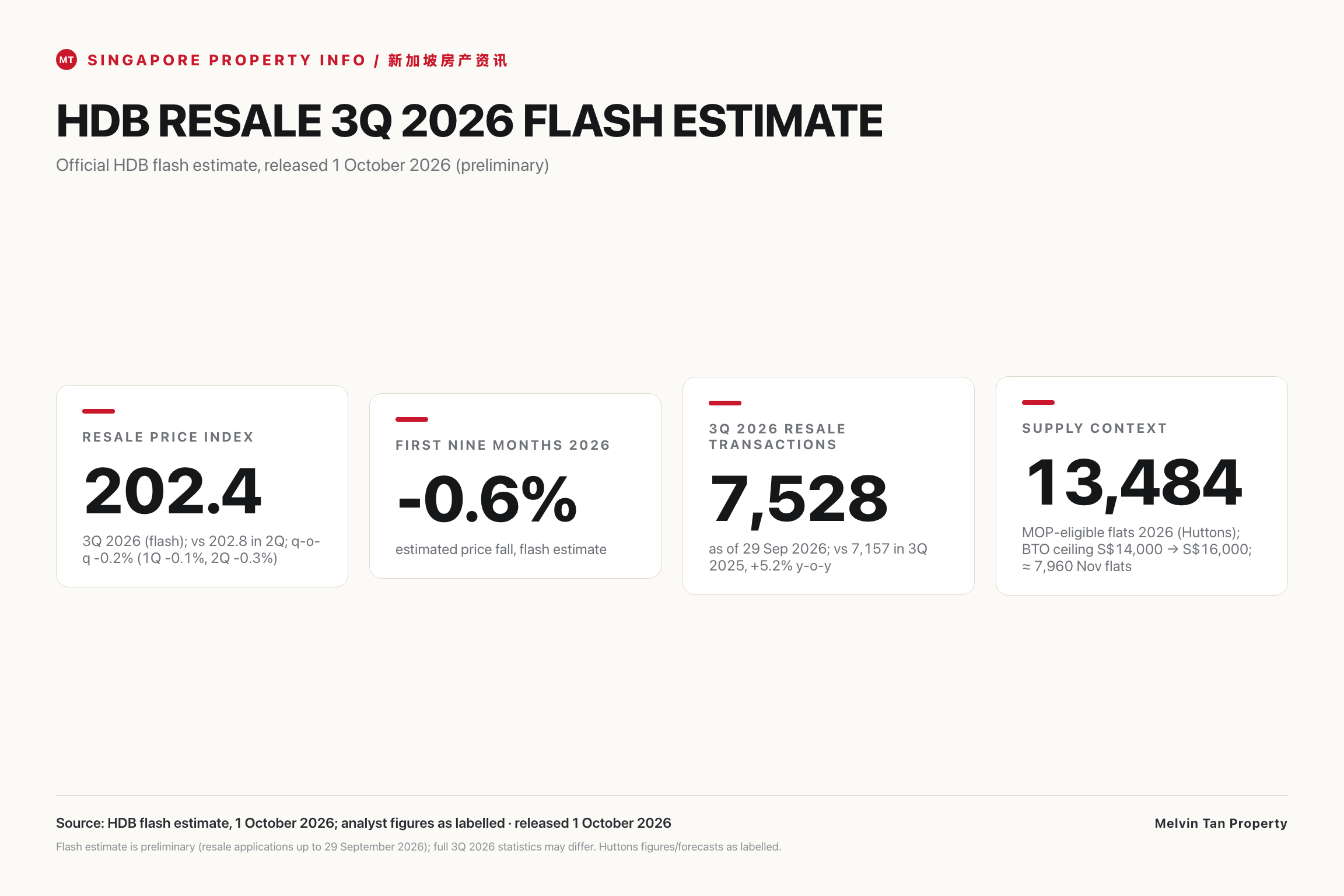
HDB released its flash estimate of the 3Q 2026 public housing data on 1 October 2026. Resale prices are estimated to have fallen 0.2% quarter-on-quarter, with the HDB Resale Price Index at 202.4 in 3Q 2026 versus 202.8 in 2Q 2026 — the third consecutive quarterly fall (1Q -0.1%, 2Q -0.3%). The estimated fall over the first nine months of 2026 is 0.6%. Resale transactions rose: 7,528 were recorded in 3Q 2026 as of 29 September, 5.2% higher than 7,157 in 3Q 2025, and HDB described volume as broadly stable. HDB also said it has not observed a significant increase in either the prices of resale flats or the number of resale flats purchased by private home owners and former private owners since the 15-month wait-out period was removed on 28 July 2026, and will continue to monitor the market. All of these are flash-estimate figures compiled from resale applications up to late September 2026; the full 3Q 2026 statistics may differ when HDB releases them.
Key takeaways
The resale price index fell for the third consecutive quarter: -0.1% in 1Q 2026, -0.3% in 2Q 2026, and an estimated -0.2% in 3Q 2026, taking the index to 202.4. The estimated 0.6% fall over the first nine months of 2026 is, per SRI research, the weakest first-nine-months performance since 2018, when prices fell 0.8% — that characterisation is an analyst assessment of the flash figures.
Resale transaction volume rose 5.2% year-on-year to 7,528 in 3Q 2026 (7,157 in 3Q 2025); HDB described it as broadly stable. Falling prices alongside stable volume is a coherent supply-side picture — more flats reaching the 5-year minimum occupation period, an expanding resale inventory, and ramping BTO and Sale of Balance Flats supply — rather than proof of a market bottom.
The 15-month wait-out period was removed on 28 July 2026. HDB has stated it has not yet observed a significant price or volume effect from private home owners and former private owners, so any media framing that attributes a resale effect to the change is not yet supported by HDB’s own statement.
Analysts expect the market could bottom in 4Q 2026 (Huttons) and pointed to 13,484 flats fulfilling their 5-year MOP in 2026 — both are Huttons figures and forecasts, not official HDB data.
HDB said the expansion of BTO and SBFL supply and the growing MOP-eligible pipeline are contributing to price moderation. The BTO income ceiling was raised from S$14,000 to S$16,000, with about 7,960 new flats launched across six towns in November.
The official flash figures
The HDB Resale Price Index is a quarter-on-quarter index, not a median or average transaction price. HDB’s 1 October 2026 flash estimate puts it at 202.4 in 3Q 2026, down from 202.8 in 2Q 2026 — an estimated 0.2% fall, and the third consecutive quarterly decline after -0.1% in 1Q 2026 and -0.3% in 2Q 2026. The estimated fall over the first nine months of 2026 is 0.6%.
Two caveats apply to every figure in this section. First, the flash estimate is preliminary: HDB compiles it from resale applications up to 29 September 2026, and the full 3Q 2026 statistics may differ. Second, the ‘weakest since 2018’ framing comes from SRI’s head of research in commentary on these flash figures — the 0.6% nine-month number itself is HDB’s flash estimate, and the characterisation of it is analyst assessment.
HDB reported the 3Q figures alongside its upcoming flat supply announcements; the same release set noted that the BTO income ceiling was raised from S$14,000 to S$16,000, with about 7,960 new flats launched across six towns in November.
What the transaction volume does — and doesn’t — tell you
HDB recorded 7,528 resale transactions in 3Q 2026 as of 29 September 2026, up 5.2% from 7,157 in 3Q 2025, and described volume as broadly stable.
That count is a number of resale applications, not a price signal, and it is a different series from the URA private-home transaction figures released the same day — the two must not be blended into one market reading.
Falling prices alongside stable or slightly rising volume is a coherent supply-side picture. More flats are reaching their 5-year minimum occupation period and becoming eligible for resale, the resale inventory is expanding, and BTO and Sale of Balance Flats supply is ramping. That combination does not, by itself, establish a market bottom — it describes a market in which choice and negotiating position are shifting, which is precisely why the timing question matters for both buyers and sellers.
The supply picture behind the falls
HDB said the expansion of BTO and Sale of Balance Flats supply and the growing pipeline of MOP-eligible flats are contributing to the price moderation. Huttons counted 13,484 flats fulfilling their 5-year minimum occupation period in 2026 — that is Huttons’ stated count, not an official HDB figure, but it points at the direction of the resale supply build-up.
On the other side of the market, the BTO income ceiling was raised from S$14,000 to S$16,000, and HDB launched about 7,960 new flats across six towns in November. For a buyer choosing between a resale flat and new public housing, the options landscape in 2026 is wider than it was a year ago, and that choice is part of the decision alongside price.
Huttons also said the removal of the 15-month wait-out period drove a rise in demand for five-room and larger resale flats, and that these two flat types saw the largest gain in sales volume in 3Q 2026. That is an analyst observation on flat-type mix, not an official finding, and no causal claim is made here from the policy change to any specific price or volume outcome.
The removed 15-month wait-out period: what HDB has observed
The 15-month wait-out period — which required former private home owners to wait 15 months after disposing of their private property before they could buy an HDB resale flat — was removed on 28 July 2026. HDB stated on 1 October 2026 that it has not observed a significant increase in either the prices or the number of resale flats purchased by private home owners and former private owners since the change, and that it will continue to monitor the resale market.
The practical reading: the removal is a real, announced demand-side change, but HDB itself says the price and volume effect has not yet shown up in the data. Any media framing that already attributes a resale-market effect to the change is not supported by HDB’s own statement at this time. As HDB continues to monitor, later releases may change that picture — this article does not read ahead into that.
Planning considerations for buyers and sellers
For buyers, the timing question is real but the data does not answer it. Analysts such as Huttons expect the resale market could bottom in 4Q 2026, and SRI has framed the 0.6% nine-month fall as the weakest since 2018 — those are forecasts and assessments, not official evidence. A purchase decision should rest on your own position: the specific flat, its price relative to comparable transactions, the total quantum including duties and financing, and your timeline. If new public housing is also on your table, the expanded BTO supply — income ceiling S$16,000 and the November launches — is a genuine alternative worth comparing against a resale flat, not a footnote. Nothing in the flash estimate changes buyer eligibility, financing rules, CPF housing rules or applicable duties; those depend on your actual situation and should be reviewed before committing, with legal or tax advice where required. No outcome is guaranteed.
For sellers, falling prices alongside broadly stable volume means listing is a decision about your move-out plan and exposure, not a certainty about where prices go. With 13,484 flats expected to fulfil their 5-year MOP in 2026 (Huttons’ count) adding to resale supply, competition for buyer attention is a live consideration when setting expectations with a listing agent.
One structural note: this article covers the HDB resale market. Melvin’s 5 October article on the URA 3Q 2026 flash estimate covered private homes — a different market, a different dataset, and a different definition. The two flash releases were published the same day but should be read separately, not blended into one ‘price trend’ for Singapore.
For HDB upgraders reviewing a full move, the EC Upgrading route is available where relevant; the review of ownership, financing and legal implications should be done for the household’s actual position, not the market headline.
FAQ
Official sources
- HDB – HDB Public Housing Data and Upcoming Flat Supply (flash estimate) – 1 October 2026
- CNA (Channel NewsAsia) – HDB resale prices fall – 1 October 2026
Further reading
This article provides general educational information based on HDB’s flash estimate, which is preliminary, and separately labelled analyst commentary. It does not value an individual flat, predict future prices or replace legal, tax, CPF, mortgage or financial advice. Verify the latest official HDB figures and project-level evidence before committing.