Quick answer
Singapore’s revised Land Betterment Charge rates apply from 1 September 2026 to 28 February 2027. SLA reported average increases for commercial, landed residential, non-landed residential, industrial and specified civic or community uses.
These are average movements across geographical sectors, not a cost estimate for a particular site. The current sector, use group, actual proposal and relevant permission date must be reviewed together.
Average rate movements by use group
Source: SLA, 31 August 2026. These figures are averages and should not be applied directly to an individual property.
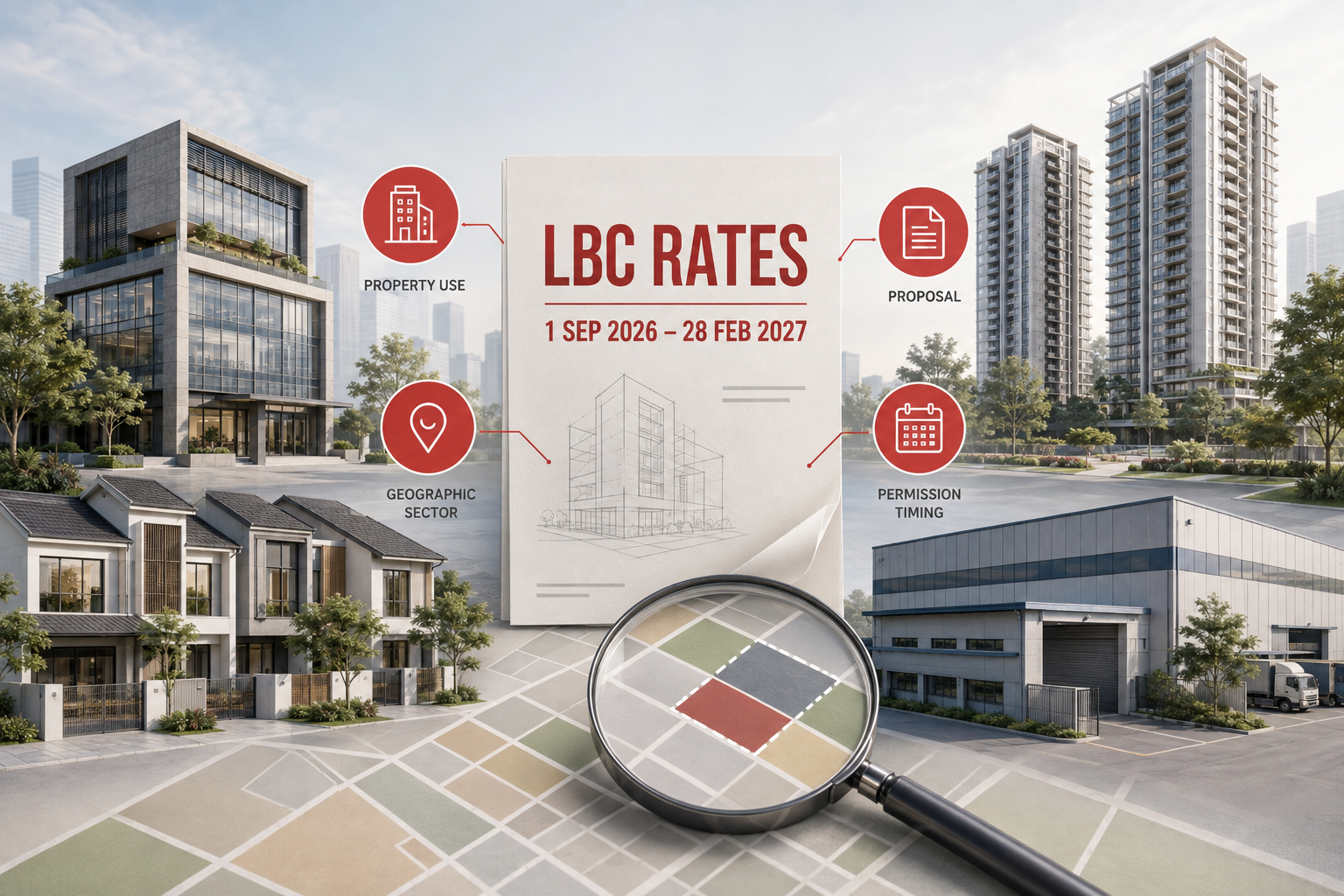
Four checks before using the rate table
Property use
Identify the applicable use group for the proposed development.
Geographical sector
Use SLA’s current sector maps, including the September boundary adjustments.
Actual proposal
Review the proposed use, intensity and relevant existing baseline.
Permission timing
Confirm when Provisional Permission or a qualifying extension is granted.
Key takeaways
- SLA published the revised rates on 31 August 2026, with effect from 1 September 2026.
- Average increases range from 1.7% for commercial use to 3.9% for industrial use among the principal property categories that changed.
- The new rates apply to cases granted Provisional Permission, or a second or subsequent extension to Provisional Permission, on or after 1 September 2026.
- An average percentage movement is not a site-specific LBC estimate.
- Owners considering redevelopment, intensification or change of use should obtain professional advice before relying on a feasibility calculation.
Background
Land Betterment Charge, or LBC, may arise when a chargeable consent increases the value of land. SLA explains that its Table of Rates method compares a post-chargeable valuation with a pre-chargeable valuation. The post-chargeable value reflects matters such as the proposed use and intensity in the relevant planning permission, while the pre-chargeable value reflects the applicable existing baseline.
This means LBC is not simply a general fee added to every property purchase or sale. Whether it arises, and the amount involved, depends on the site and proposal.
Latest update
SLA’s 31 August 2026 release sets the LBC schedule for 1 September 2026 to 28 February 2027.
| Use group | Average movement | Sector detail |
|---|---|---|
| A — Commercial | Up 1.7% | 46 of 118 sectors rose by about 3% to 19%; 72 were unchanged |
| B1 — Landed residential | Up 3.5% | 108 sectors rose by about 2% to 8%; 10 were unchanged |
| B2 — Non-landed residential | Up 3.4% | 70 sectors rose by about 1% to 29%; 48 were unchanged |
| C — Hotel or hospital | Unchanged | No rate change reported |
| D — Industrial | Up 3.9% | All 118 sectors rose by about 2% to 10% |
| E — Place of worship, civic or community institution | Up 2.9% | Average increase across all sectors |
| F, G and H | Unchanged | No rate change reported |
The rates are expressed per square metre and must be read with the applicable use group and sector. Refer to SLA’s current table and maps for the site-specific starting point.
Who is affected
The revision is most relevant to owners, prospective owners, developers and investors assessing a proposal that may involve chargeable consent, including a change in use or development intensity.
It may also matter to subsidiary proprietors evaluating a collective-sale proposal because a potential purchaser’s development assumptions can affect feasibility. A higher published rate does not automatically determine a collective-sale outcome; tender terms, planning potential, construction costs, financing, market conditions and other obligations also matter.
SLA states that the new schedule applies where Provisional Permission, or a second or subsequent extension to Provisional Permission, is granted on or after 1 September 2026.
Who is not affected
An ordinary homeowner buying, selling or occupying a property without a relevant chargeable consent should not assume that the published LBC percentage increases are a direct transaction levy.
The figures also do not establish the liability for a particular site. Owners whose plans remain within an existing authorised use and intensity still need case-specific advice before concluding whether LBC applies.
What remains unchanged
SLA reported no change to the Use Groups Table or the total number of geographical sectors.
Rates for hotel and hospital use under Use Group C remained unchanged. Rates for Use Groups F, G and H also remained unchanged.
SLA made minor boundary adjustments to sectors 7, 16, 23 and 35 to align them with zoning demarcations in URA’s Master Plan 2025. Site identification should therefore use the current maps rather than an older sector assumption.
Planning considerations
1. Identify the actual proposal
Start with what is being considered: continued existing use, intensification, redevelopment or change of use. A broad property label such as “commercial” or “industrial” is not enough to establish the correct treatment.
2. Confirm the current sector and use group
Use SLA’s current sector maps, Use Groups Table and September 2026 rate table. Do not rely on a previous schedule or a district-wide average.
3. Check the permission date
The operative schedule depends on when the relevant Provisional Permission or qualifying extension is granted. Submission, option and completion dates should not be treated as substitutes for the official application rule.
4. Treat the rate as one part of feasibility
A development or collective-sale assessment should also consider planning controls, allowable intensity, construction and financing costs, applicable duties and taxes, professional fees, project timing and market risk.
5. Use estimates carefully
SLA provides an online LBC Estimator for selected proposals. An estimate is useful for early review, but it should not replace advice from the relevant planning, valuation, legal and tax professionals where required.
FAQ
Official sources
This article provides general educational information based on SLA’s published schedule. Confirm the latest official rate table, maps and professional advice for the actual site and proposal before making a property decision.