By Melvin Tan Property
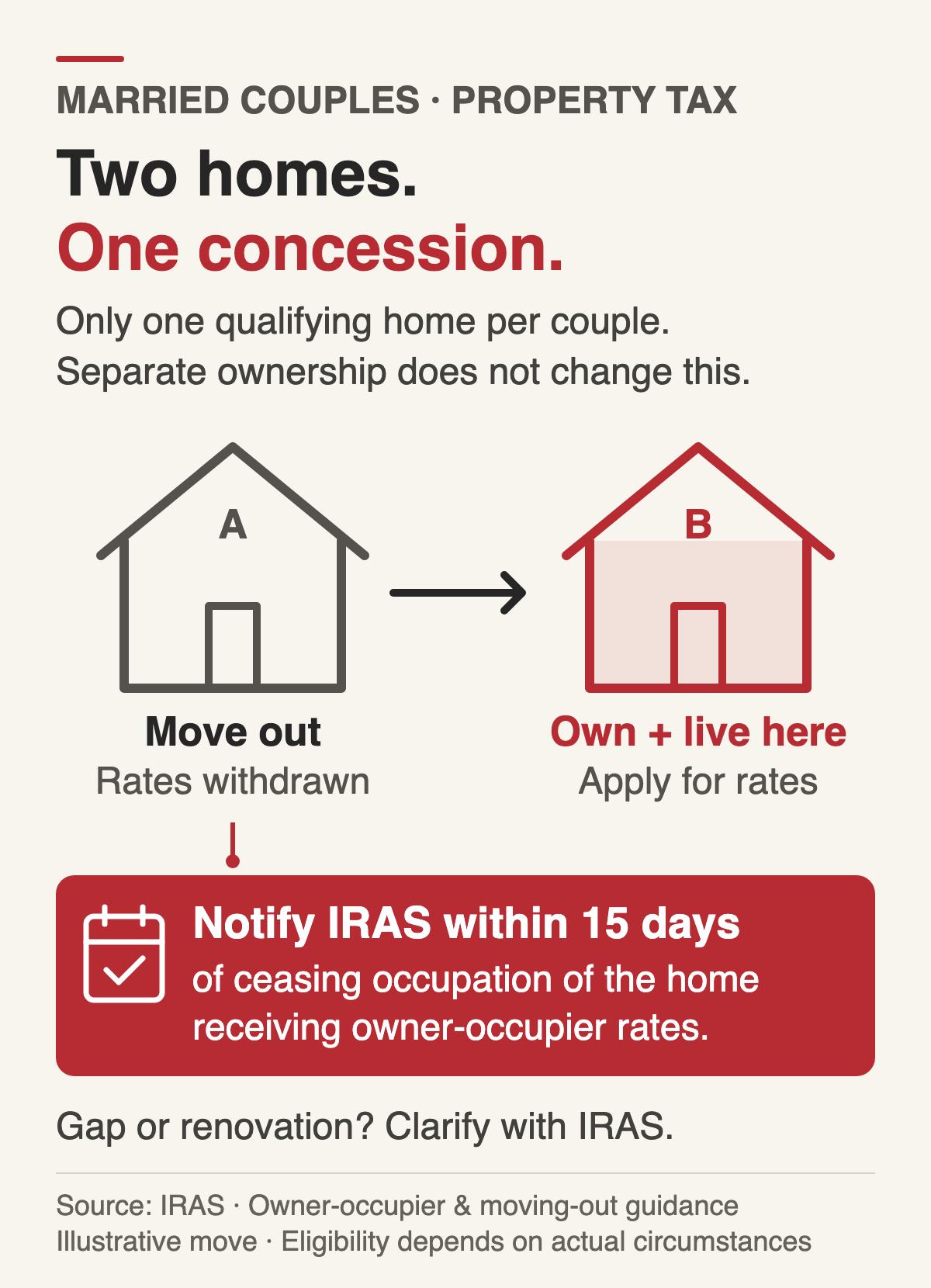
A married couple owning two Singapore homes cannot receive owner-occupier property tax rates on both, even if each spouse lives in a different home. The concession requires ownership and residence, and applies to only one home for the couple. IRAS eligibility guidance.
Summary
Married couples have a one-home owner-occupier concession limit. If you cease occupying a home receiving the concession, notify IRAS within 15 days.
Separate ownership does not create a second concession
For example, consider a husband who owns and occupies home A and a wife who owns and occupies home B. Those facts do not establish entitlement to two concessions.
Ownership and occupation should therefore be considered together. A title document establishes an ownership position; it does not by itself establish that the owner lives there. Equally, an intention to move into a newly purchased home should not be treated as proof that occupation has already begun.
This article concerns recurring property tax. It does not determine BSD, ABSD, financing eligibility, or whether a household may acquire or retain a particular property. For the wider decisions surrounding a purchase, the guide to buying a second property while keeping your first home provides a separate planning starting point.
Moving from home A to home B: map the actual transition
IRAS gives a specific example involving an existing private property or HDB flat, A, and a recently purchased private property, B. An owner living in B can apply for owner-occupier rates there. In that example, the concession on A ceases from the date the concession starts on B. IRAS two-property scenario.
Read that example alongside the separate move-out obligation. The example does not establish that A keeps its concession after you stop occupying it simply because an application for B has not yet been made. IRAS states that owner-occupier rates are withdrawn when an owner moves out. IRAS moving-out guidance.
Suppose you complete the purchase of B while still living in A. Completion alone should not be treated as occupation of B. If you later leave A but cannot immediately occupy B, do not assume that the concession automatically follows ownership throughout the gap. The tax treatment of that gap or a renovation period needs clarification from IRAS based on the actual circumstances.
Build a move checklist around the notification obligation
For owners paying owner-occupier rates, the notification deadline is within 15 days from the date they cease to occupy the property. IRAS does not describe this as a deadline measured from selling the property or receiving the next annual bill. IRAS notification deadline.
Use this checklist to organise the move:
- Before the move, check both property records. Note the current tax-rate category and keep the latest notices accessible.
- Record the actual occupation dates. Keep the dates for A and B distinct from completion, key collection and renovation milestones, and record any intervening living arrangements.
- Diarise the notification promptly. Do not leave the administrative task until a sale or tenancy decision is finalised.
- Submit the change through IRAS’s service. Retain your submission record so that you can follow up against the facts you supplied.
- Review the revised notice. Compare the property and occupation details with your records, and raise any discrepancy with IRAS.
IRAS’s published steps are to log in to myTax Portal with Singpass, select “Property”, then “Apply/Withdraw Owner-Occupier Tax Rates”. After receiving the notification, IRAS says it will send a notice showing revised tax payable based on non-owner-occupier residential tax rates. The relevant service is Apply/Withdraw Owner-Occupier Tax Rates.
The obligation has consequences beyond household budgeting. IRAS states that non-compliance carries a fine of up to $5,000 and interest on the tax at such rate as may be prescribed, if any. That is the published maximum fine, not a statement that every late notification attracts that amount. IRAS non-compliance provision.
Check the rate category before estimating holding costs
Your latest property tax bill indicates whether owner-occupier rates apply. IRAS also provides the View Property Summary service. Checking the recorded category is a useful first step before using a previous bill as a budgeting reference.
IRAS’s owner-occupier schedule effective from 1 January 2025 is progressive: different portions of Annual Value fall into different bands. Its published examples give the following property tax amounts for 2026. These examples concern qualifying owner-occupied properties; they are not estimates for your second home or a mid-year move. IRAS rates and worked examples.
| Annual Value in IRAS example | Owner-occupier property tax for 2026 |
|---|---|
| $12,000 | $0 |
| $36,000 | $960 |
| $84,000 | $5,480 |
For the $36,000 example, the first $12,000 is taxed at 0%, and the next $24,000 at 4%, giving $960. Applying 4% to the whole $36,000 would misread the progressive schedule. Use the Annual Value and applicable category for the actual property when reviewing your own position.
For planning purposes, keep separate cost entries for A and B, with space for updated assessments after the move. A previous owner-occupier bill for A is not a reliable basis for assuming its future bill will remain unchanged.
Do not assume the concession is automatic for every purchase
IRAS lists automatic application for buyers of new or resale HDB and DBSS flats, and new executive condominiums. For a Singapore Citizen or Permanent Resident buying a new or resale private residential property, its stated automatic-application condition is that the buyer and spouse are not currently enjoying owner-occupier rates on another residential property. IRAS automatic-application guidance.
IRAS also says that buyers who do not intend to reside in the property should notify it to withdraw owner-occupier rates. Where you are residing in a property but it is taxed at non-owner-occupier residential rates, the same guidance provides for an application through the Apply/Withdraw service and checking the application’s status there.
The practical lesson is to check the recorded treatment against your circumstances, rather than assuming that a purchase record resolves every eligibility question. If your household has unresolved acquisition or holding decisions, work through the broader second-property planning questions before committing to a timeline.
When a straightforward move needs individual review
Vacancy, renovation, temporary overseas absence, trusts, non-spouse co-ownership and deceased estates should not be resolved by applying a simple A-to-B example without reviewing their particular conditions. IRAS’s guidance contains separate scenarios, and the married-couple example is not a substitute for those rules. IRAS eligibility and scenarios.
The examples and checklist are illustrations and practical organisation advice, not individual eligibility determinations or an official evidence list. Seek IRAS clarification or professional tax advice where the facts are unusual; no tax outcome is guaranteed. If you would like help organising the wider property move and its sequence, discuss your second-property plans with Melvin. Keep tax eligibility questions with IRAS or an appropriately qualified adviser.