Quick answer
Seller’s Stamp Duty, or SSD, may apply when residential property is sold or otherwise disposed of within the applicable holding period. For property purchased on or after 4 July 2025, the current residential schedule runs for four years at 16%, 12%, 8% and 4%.
The applicable rate is generally applied to the higher of the selling price or market value. Before setting a sale deadline, confirm the acquisition date, disposal date, applicable schedule and transaction value.
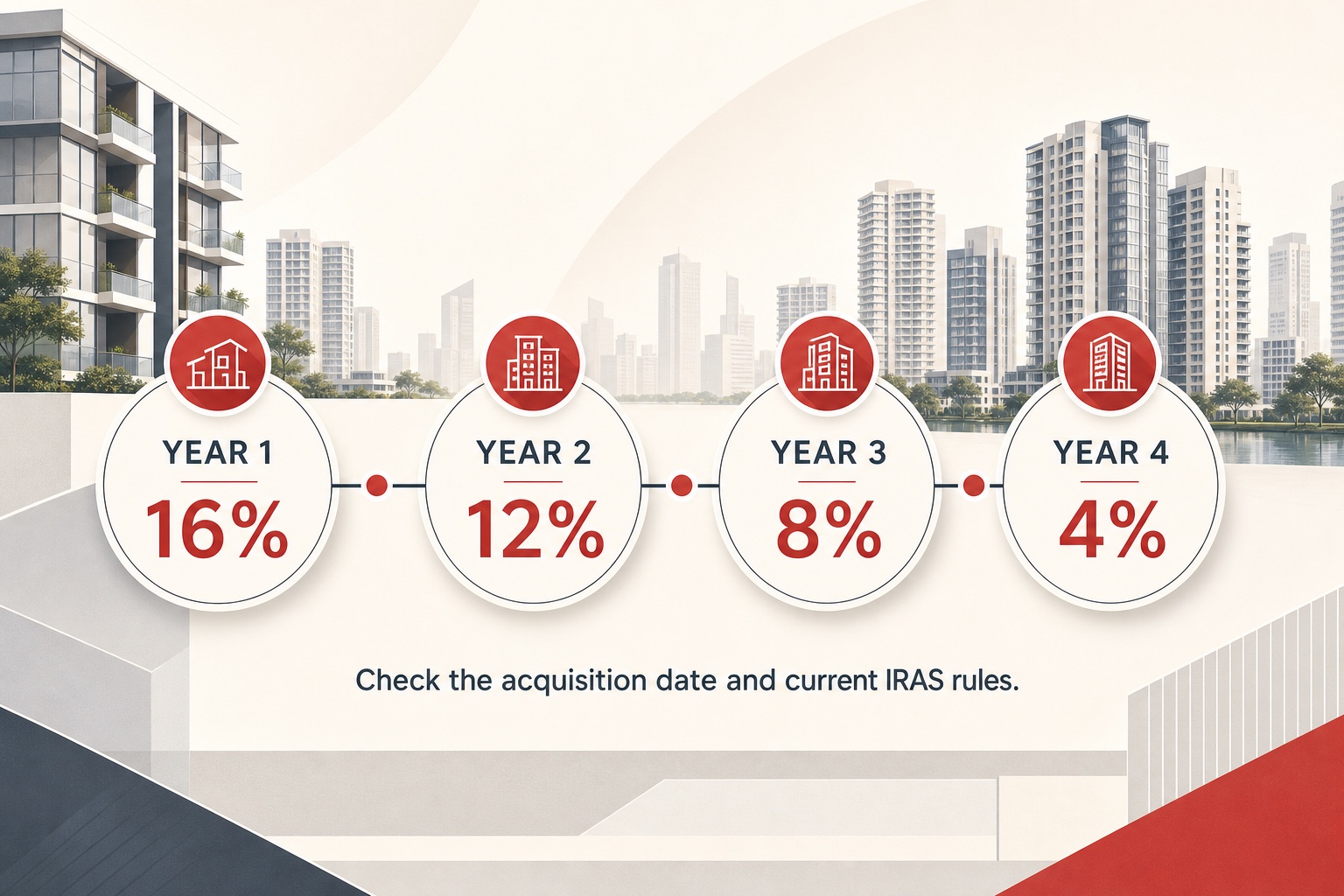
Residential SSD schedules at a glance
| Holding period | Purchased 11 Mar 2017–3 Jul 2025 | Purchased on or after 4 Jul 2025 |
|---|---|---|
| Up to 1 year | 12% | 16% |
| More than 1 year and up to 2 years | 8% | 12% |
| More than 2 years and up to 3 years | 4% | 8% |
| More than 3 years and up to 4 years | No SSD under this schedule | 4% |
| More than 4 years | No SSD under this schedule | No SSD under this schedule |
Older acquisitions can fall under different historical schedules. Always identify the acquisition period and check the current IRAS guidance before applying a rate.
Key takeaways
- Residential SSD can apply to qualifying residential property or land acquired on or after 20 February 2010 and disposed of within the relevant holding period.
- Purchases on or after 4 July 2025 use the published four-year schedule shown above.
- Residential property purchased from 11 March 2017 to 3 July 2025 generally remains under the earlier three-year schedule.
- SSD is generally calculated using the higher of the selling price or market value at disposal.
- The relevant legal-document dates matter; marketing, moving or completion dates do not necessarily determine the holding period.
- Special ownership histories and exemptions should be verified rather than assumed.
Background
SSD is separate from duties connected to buying property. The Government uses residential SSD to discourage short-term speculative transactions that could distort underlying property prices.
On 3 July 2025, the Ministry of National Development, Ministry of Finance and Monetary Authority of Singapore announced that the residential holding period would return from three years to four years, with each rate tier increased by four percentage points. The revised schedule applies to qualifying residential property purchased on or after 4 July 2025.
Latest update
The change took effect for residential property purchased on or after 4 July 2025. IRAS states that an Option to Purchase accepted on or after that date uses the revised schedule even if the option was granted earlier.
How the duty is calculated
IRAS computes residential SSD on the higher of the actual selling price or the market value at the date of sale or disposal.
Who is affected
This guide is primarily relevant to private residential property owners and residential landowners considering disposal within the applicable holding period.
It can also matter where only part of an ownership interest is disposed of, interests were acquired at different times, the property came through inheritance or another transfer, the property forms part of a collective sale, or the site’s use changed to residential or mixed residential use.
Who is not affected
A seller will generally have no residential SSD under the published schedule after the applicable holding period has fully expired. The correct expiry point depends on the acquisition date and schedule.
The joint announcement stated that the revised schedule would not affect ordinary HDB owners because HDB flats are subject to a Minimum Occupation Period. Unusual HDB and replacement-flat situations should still be checked separately.
What remains unchanged
- The transaction and property interest must be classified correctly.
- SSD remains separate from CPF refund, loan redemption, legal costs, agency fees and other sale adjustments.
- The higher of the selling price or market value remains the general calculation basis.
- The relevant acquisition and disposal dates depend on the legal instrument.
- Exemptions and special rules must be checked against the actual facts.
Planning considerations
1. Establish the acquisition date first
In common transactions, IRAS identifies the acquisition date as the accepted OTP date, the Sale and Purchase Agreement date, or the transfer date when earlier documents do not apply. Do not estimate it from key collection, move-in or TOP without checking the applicable rule.
2. Identify the legal disposal date
The disposal date is commonly the date the buyer accepts the seller’s OTP, the Sale and Purchase Agreement date, or the transfer date. A seller near the end of a holding period should not rely only on the intended completion date.
3. Review the complete estimated proceeds
Assess SSD alongside the outstanding housing loan, CPF principal and accrued interest, legal and agency fees, adjustments and the timing of any replacement home. See the CPF refund guide for a separate component of the sale calculation.
4. Check unusual ownership histories early
Inheritance, gifts, matrimonial transfers and changes in ownership shares can alter the acquisition-date analysis. IRAS states that an inherited interest generally takes the deceased owner’s acquisition date for SSD purposes, while other transferred interests may require their own review.
5. Do not assume a collective sale removes SSD
IRAS ties the disposal date for a collective sale to the executed collective-sale contract. Owners within the applicable holding period may remain liable, including non-consenting owners.
6. Confirm administration with the lawyer
IRAS states that SSD must generally be paid within 14 days of the executed sale contract. Confirm the amount, payment arrangement and required declaration with the lawyer handling the transaction.
FAQ
Official sources
This article provides general educational information. Sellers should verify the current IRAS rules and obtain legal, tax, CPF and financing advice for the actual transaction before committing.