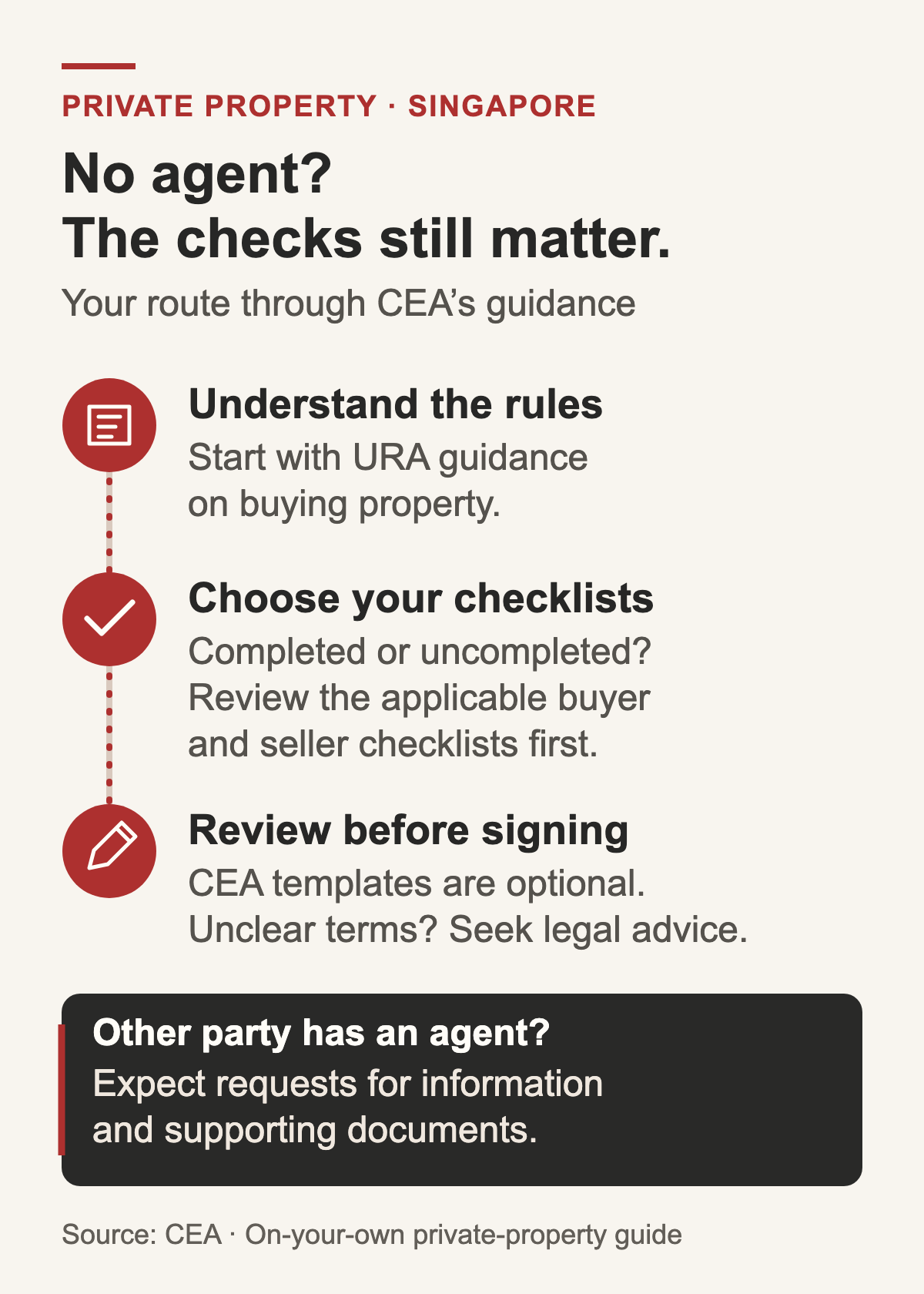
What the on-your-own route looks like
Buyers and sellers of private residential property in Singapore can transact without engaging a property agent. The supporting CEA guide is a “broad overview of the process” (last updated 22 July 2026) and advises anyone unfamiliar with the transaction process, or needing assistance, to consider engaging a property agent. Its guidance on engaging a property agent is a relevant next reference if that describes your position.
The three steps, taken one at a time
The regulator’s guide condenses the route into three steps, and each one leaves concrete work with the buyer and seller.
Step 1 — familiarise yourself with the rules and regulations. The guide’s first step links out to the Urban Redevelopment Authority’s guidelines on buying property as the starting reading. As a practical starting point, read the referenced guidance to identify which questions apply to your situation, rather than treating a listing or an informal conversation as the complete basis for a decision.
Step 2 — go through the relevant checklists before signing. The Council for Estate Agencies encourages parties to work through the applicable checklist before entering into any contract to buy or sell. Four are published, as a buyer’s and seller’s checklist for completed private residential property and a separate buyer’s and seller’s checklist for uncompleted private residential property. The first decision is simple: identify whether the property is completed or uncompleted, then read the pair of checklists that matches. If you are unsure which checklist applies, resolve that question before treating the checklist review as complete.
Step 3 — negotiate and sign the contract. CEA offers two standard documents: an Option to Purchase for private residential property and an Agreement for the sale and purchase of private residential property. Its wording is that parties “may wish to use” them, so they are presented as options. Seek legal advice on the actual agreement if its terms, dates or special conditions are unclear; the availability of a template alone does not answer questions about its suitability for your transaction.
If one side already has an agent
One party may appoint a property agent while the other acts on their own. CEA addresses this situation in its closing note. Where the other party is represented by a property agent, that agent’s due-diligence process still reaches the unrepresented side: you will be asked to provide information and supporting documents as part of the agent’s checks. A dedicated Council for Estate Agencies page on preventing money-laundering, proliferation financing and terrorism financing explains the documentation gathering behind those requests.
The practical point is to clarify roles early. If you receive a request for information, ask what is required and which part of the transaction the request relates to. Receiving a request should not be confused with appointing that agent to advise you. If you need help deciding whether to appoint someone, our guide on how to choose a property agent in Singapore sets out questions to consider. Our private property resale timeline also maps the offer-to-completion sequence and can help you organise questions about your own timetable.
Deciding how much help you need
Finding a counterparty directly addresses one part of the transaction; it does not answer how you will work through the documents. Before deciding to manage the process yourself, be realistic about what is familiar and what is not. You might be comfortable contacting a seller or arranging a viewing but still want help understanding proposed terms. Deciding where to get that help is a separate question from whether an agent introduced the property.
As a planning step, write down the points you want clarified before the next commitment. Keep track of which questions have been answered and which still need attention. If you and the other party are discussing a document, be clear about which version you are referring to. These practical habits can make the discussion more precise.
Where to get help
If you are already dealing with a counterparty who hasn’t engaged an agent — or you are simply unsure who arranges the checklists, the contract drafting and the due-diligence requests — Melvin Tan Property can walk you through what engaging a registered property agent actually involves in this kind of deal, including what to verify before signing anything. Discuss your property transaction with Melvin. There is no obligation to engage anyone, and no promise about outcomes.
Official sources
- Buying or Selling a private residential property — Council for Estate Agencies – retrieved 23 October 2026 (page last updated 22 July 2026)
- Engaging a property agent — Council for Estate Agencies – cited from the CEA page above
- Preventing money-laundering, proliferation financing and terrorism financing — Council for Estate Agencies – cited from the CEA page above
This article provides general planning information based on the Council for Estate Agencies’ own guidance. It does not value an individual property, guarantee any transaction outcome, or replace legal, tax, financing or professional advice. Verify current official guidance and your own circumstances before committing to anything.