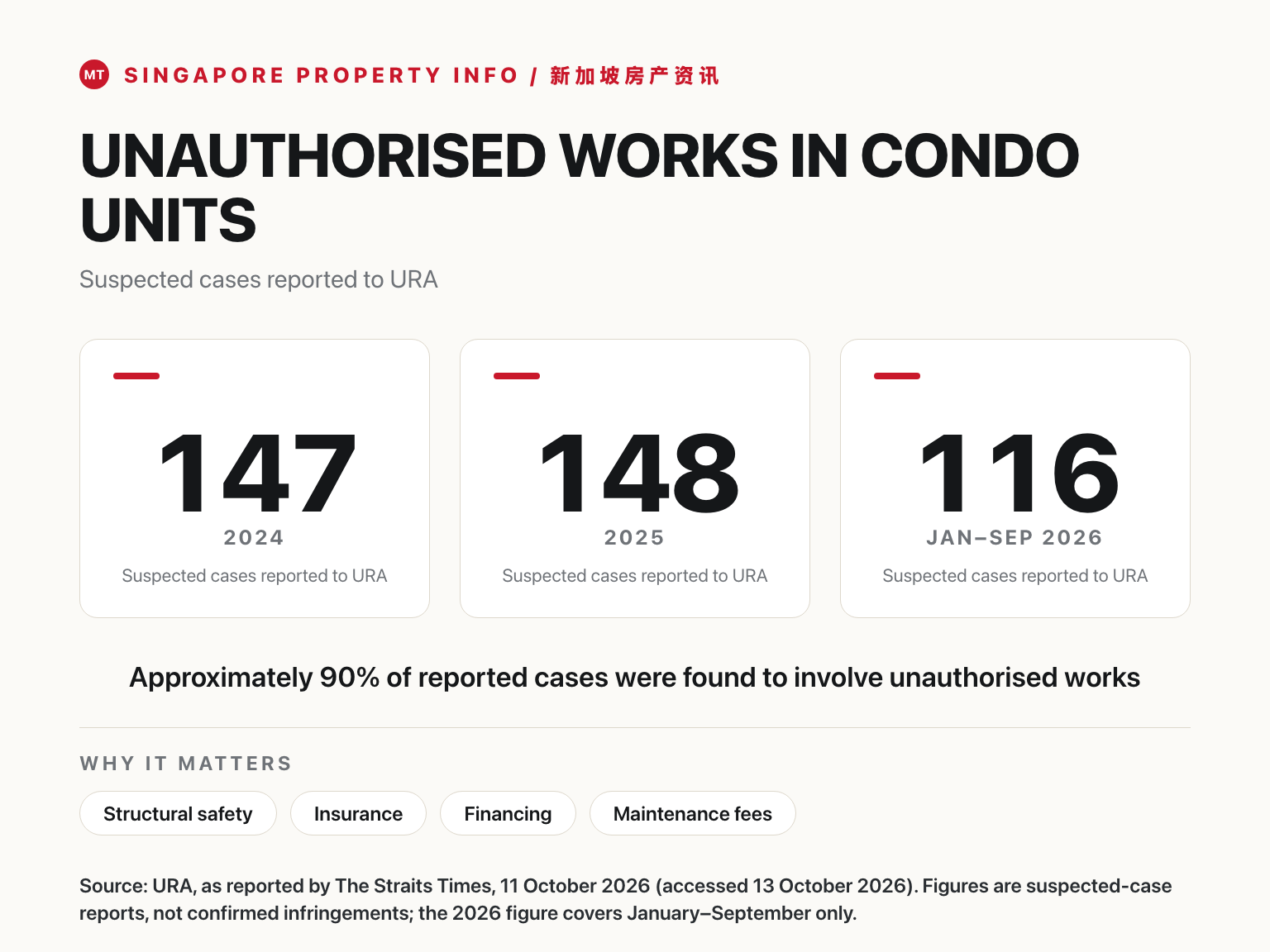
Unauthorised alterations to condominium units remain a concern in Singapore. According to a statement attributed to the Urban Redevelopment Authority (URA) on 11 October 2026, the agency received 116 reports of suspected unauthorised works in the first nine months of this year, following 148 in 2025 and 147 in 2024.
The issue extends beyond whether an alteration looks safe or improves a home’s usable space. Works carried out without the necessary approvals can leave owners facing rectification costs and raise questions about insurance, financing and the property’s approved floor area. For buyers, the concern is whether they could inherit an unresolved problem after completing a purchase.
Most reported cases involved unauthorised works
Of those reports, URA said about 90% were found to involve unauthorised works — a proportion of the reported cases, not a statement that every report confirmed an offence. The 2026 figure covers only the first nine months of the year, so it is not a full-year comparison. On enforcement, action was initiated in a number of cases — no count was published — and most unauthorised works were removed following enforcement action without court action. URA added that it “will not hesitate to prosecute offenders in court if they do not comply.”
Why unauthorised alterations can become costly
Structural safety. The Building and Construction Authority (BCA) has investigated an average of about 50 reported cases of unauthorised structures annually in strata-titled residential developments over the past three years, and most were assessed to be structurally safe. The structures considered unsafe generally lack adequate support or anchoring, or impose loads exceeding the capacity of the existing floor structure. BCA’s figure counts cases it investigates and does not include cases referred to URA, so it is not directly comparable to URA’s report counts.
Insurance. The General Insurance Association of Singapore (GIA) said unauthorised structures may lead to out-of-pocket expenses: claims linked to or caused by unauthorised works or structural modifications may not be covered when loss or damage occurs. Specific policy coverage varies, so the owner’s or buyer’s own insurer should be asked directly about any works in the unit.
Financing. URA listed property financing among the implications. Works that breach planning or building rules can create exposure in the home loan relationship, including loan conditions tied to the property’s approved condition, so it is prudent to raise the question with the lender’s side of the transaction before committing.
Maintenance fees. An owner’s maintenance-fee share is based on floor area. Where added floor area was never approved, the owner enjoys extra space without a corresponding fee adjustment — which URA frames as an equity question for the rest of the development.
What a buyer should check before offering
The statement gives a buyer a concrete diligence sequence for any condo, new or resale:
- Look for works that change the usable space. A mezzanine or loft, an enclosed roof terrace, a closed-in first-storey patio or pool deck, or a structure over a semi-outdoor area — any of these may have been added without the required approvals.
- Ask the seller for the approval record. The relevant records are the MCST’s approval for the works, the URA or BCA approvals (planning permission or permit to commence, as applicable), and the qualified person’s assessment where one was commissioned. The absence of a record is itself a finding.
- Engage a qualified person where the position is unclear. Where the seller’s documents do not establish the approval position, or where the development’s records leave a question open, a qualified person can inspect the works and confirm whether the necessary approvals exist.
- Price the position before committing. If works need to be removed or regularised, that cost and timeline belong in the buyer’s decision, and the loan arrangement should reflect the unit’s actual approved condition.
This framework applies to strata-titled private units. HDB flats are subject to separate rules and are outside this article’s scope. None of these steps is legal advice; a lawyer should review the specific documents where the position is unclear.
If the works are already in place: the regularisation pathway
Discovering unauthorised works does not necessarily mean an owner can obtain retrospective approval. The available options depend on the nature of the alteration, the applicable planning and building requirements, and whether the necessary approvals can be secured. Owners may need to remove the works or engage a qualified person to assess whether regularisation is possible.
Remove the works. This is the route most commonly taken after enforcement action: URA said most unauthorised works were removed following enforcement without court action.
Retain the works with approvals. Where the works increase the unit’s gross floor area, a 90% AGM resolution applies; a qualified person then prepares and submits the application to URA. Approval, where granted, covers the planning and building requirements for the additional floor area, which may then be subject to a land betterment charge where the development’s total gross floor area has exceeded its paid-up gross floor area — a site-specific condition, and the charge amount is not quantified in the statement. The site’s land betterment charge review covers the current rates and how the charge works.
Where the decision to remove or retain is being made, a qualified person is the right first contact, and a lawyer should review the specific documents and the transaction’s exposure where the position is unclear or enforcement contact has occurred. This is the current owner’s responsibility, including where the works were in place at the time of purchase. For a seller, the planning point is to resolve the position before the unit is marketed, not mid-transaction: enforcement exposure, the S$200,000 fine and/or two-year imprisonment under the Building Control Act, and a land betterment charge are all easier to plan for before an offer is on the table. For a buyer, the same information shapes the decision: a unit with an unresolved works position carries a cost, a timeline, and a financing question that belong in the offer stage, not the post-completion stage.
Check the approvals before the purchase
An attractive renovation can add to a property’s appeal, but buyers should distinguish between the space they can see and the alterations that have actually been approved. Where the records are incomplete, resolving the uncertainty before committing is preferable to discovering the cost and complications after completion.
Sources
- The Straits Times — “URA flags persistent trend of suspected cases of unauthorised works in residential units”, 11 October 2026. Reader-accessible report of the statements issued by URA, the General Insurance Association of Singapore and the Building and Construction Authority on 11 October 2026.
- URA (Urban Redevelopment Authority), General Insurance Association of Singapore, and Building and Construction Authority — statements of 11 October 2026, as reported by The Straits Times (the URA press-release URL was not independently located).
September 2026 Land Betterment Charge Rates (the charge that can apply when regularised floor area exceeds a development’s paid-up amount) · Condo maintenance fees and sinking fund buyer guide (the maintenance-fee equity question) · Property in Singapore: Tax Guide for Homeowners
This article is a compliance review of URA’s 11 October 2026 statement. It provides general information and does not constitute legal, insurance or tax advice; the penalties cited are statutory maximums, not typical outcomes. Whether a specific unit has a works problem is a question for the unit’s own records and the professionals engaged on it.