Quick answer
Eligible CPF members may use Ordinary Account savings for a private residential purchase in Singapore, including permitted purchase, housing-loan, stamp-duty and legal costs. The amount available is not simply the buyer’s full OA balance.
Usage can depend on the property’s remaining lease, purchase price and valuation, loan type, buyer age and whether this is a first or subsequent property. Plan cash, CPF and financing together before committing.
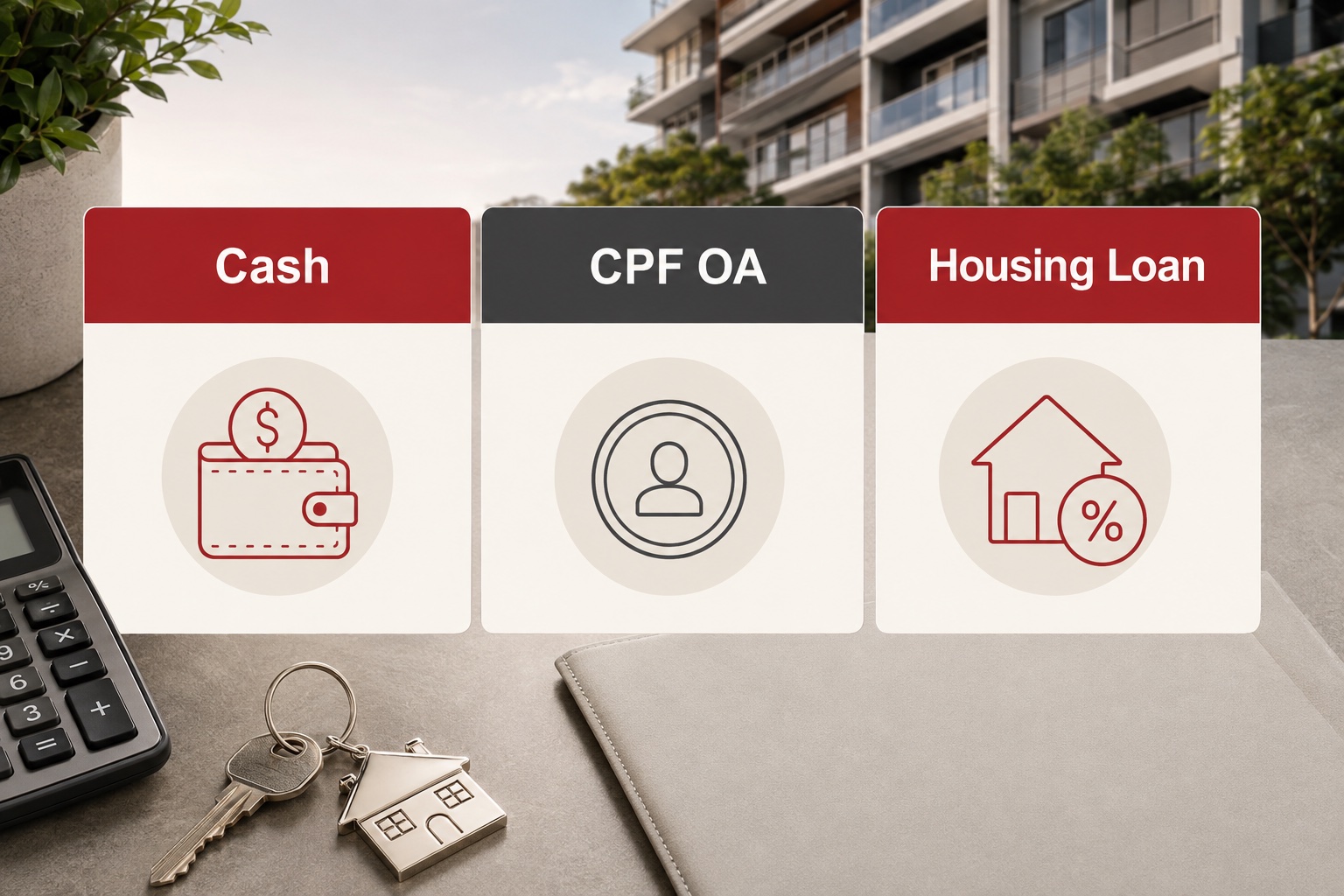
Build the purchase plan in three parts
Cash
Option money, any required cash downpayment, early transaction costs and a practical reserve.
CPF OA
The amount permitted for this property after the applicable housing and remaining-lease checks.
Housing loan
The amount and timing the bank is prepared to approve for the actual purchase.
The maximum available from each source is not automatically a comfortable total housing budget.
Five checks that can change CPF usage
| Check | Why it matters | Confirm with |
|---|---|---|
| Remaining lease | Usage may be pro-rated when the lease cannot cover the youngest CPF user until age 95. A property generally needs at least 20 years of remaining lease. | CPF Board |
| Price and valuation | The applicable housing limit may use the lower of the purchase price and valuation as its starting point. | CPF Board and lawyer |
| Loan type | The permitted sequence and housing limits differ according to the financing arrangement. | CPF Board and bank |
| Buyer age | Age interacts with the remaining lease and can affect the allowable amount. | CPF Board calculator |
| Ownership position | A purchase before selling the current home may be treated as a subsequent property, while CPF tied to that home remains unavailable until the refund is credited. | CPF Board and lawyer |
Key takeaways
- Only CPF Ordinary Account savings are generally available for a private residential purchase.
- CPF housing limits can restrict total usage even when the OA balance is higher.
- The remaining lease matters, particularly for older leasehold properties.
- A bank-financed purchase still requires a cash plan under prevailing lending requirements.
- Stamp duty for a completed property generally has to be paid in cash first and may be reimbursed from OA at completion, subject to CPF requirements and available savings.
- CPF principal used, together with accrued interest, generally has to be refunded when the property is sold or transferred.
- The permitted CPF maximum is not the same as a comfortable housing budget.
Background
CPF savings support both housing and retirement. The Private Properties Scheme allows eligible members to use OA savings for private residential property in Singapore, subject to housing limits and legal procedures.
CPF Board states that OA savings may be used for permitted downpayment, housing-loan, stamp-duty and legal costs. A buyer using CPF with a bank loan normally applies through the conveyancing lawyer, and a CPF charge is lodged against the property to secure the required future refund.
These rules sit alongside the normal purchase checks. Buyers still need to confirm eligibility, financing, applicable duties, contractual deadlines and the property’s legal position.
Latest position
This is an evergreen planning guide, not an announcement of a new CPF policy. Current CPF Board guidance says OA usage depends on the remaining lease, property and loan type, and whether the member is buying a first or subsequent property.
When a bank-financed property can cover the youngest CPF user until age 95, OA usage is generally assessed against the lower of the purchase price and valuation. Further usage may be possible up to the applicable housing limit when the relevant retirement-sum condition is met. When the lease cannot cover the youngest CPF user until age 95, the applicable CPF limit may be pro-rated.
Use CPF Board’s housing-usage calculator or Home ownership dashboard rather than relying on a generic percentage.
Who is affected
This guide is relevant to CPF members considering a completed resale condominium or apartment, an uncompleted private residential project, an eligible private landed purchase, replacing an existing home with private property, or buying another residential property while retaining the current home.
It is especially useful where the purchase depends on combining cash, OA savings and a bank housing loan.
Who is not affected
This guide does not determine whether a particular buyer is eligible to purchase restricted residential property, whether a bank will approve a loan, the duties payable, the CPF treatment of commercial or industrial property, the legal effect of a contract, or how much a buyer should spend.
Use the relevant authority, bank and conveyancing advice for those separate questions.
What remains unchanged
Using CPF does not change the purchase price, property valuation, loan-to-value assessment, TDSR review or applicable duties. It does not make an otherwise ineligible property purchase eligible.
Buyer’s Stamp Duty applies to acquisitions of Singapore property and is based on the purchase price or market value, whichever is higher. CPF availability does not remove that liability.
CPF Board also states that monthly maintenance charges, property taxes and other costs relating to the use of the property cannot be paid from OA under the housing scheme. Those expenses require a separate cash budget.
Planning considerations
1. Calculate cash, CPF and borrowing separately
Start with cash available without exhausting the emergency reserve, OA savings permitted for this property, and the housing loan the bank is prepared to approve. Use the CPF housing-usage calculator with the buyers’ ages, valuation, purchase date and lease information.
2. Check the remaining lease early
A shorter remaining lease can reduce the amount of CPF available. Check this before making an offer, particularly for an older leasehold property.
3. Plan for cash timing before completion
Some costs arise before CPF funds can be released. CPF Board explains that buyers of completed properties generally pay stamp duty in cash first and seek reimbursement from OA at completion, subject to the CPF charge, application process and available savings.
4. Keep the permitted maximum separate from affordability
Using more CPF can reduce the cash needed today, but it also leaves less CPF invested for retirement and increases the amount, including accrued interest, that generally has to be restored after a future sale. Review monthly comfort using the property instalment calculator and TDSR affordability guide.
5. Treat a subsequent-property purchase as a separate calculation
If the current home has not been sold, the new purchase may be treated as a second or subsequent property for CPF-usage purposes. OA savings tied to the current home remain unavailable until the sale completes and the required refund is credited.
6. Understand the eventual refund
When the property is sold or transferred, CPF principal used and accrued interest generally have to be refunded from the transaction proceeds, subject to prevailing rules. The CPF refund guide explains the seller-side calculation.
FAQ
Official sources
- CPF Board — Using your CPF to buy a home
- CPF Board — How much CPF savings can I use for my property purchase?
- CPF Board — Which property-related fees can I use my CPF savings for?
- CPF Board — What should I look out for if I am buying a property?
- CPF Board — How much CPF OA can you use for your next home?
- IRAS — Buyer’s Stamp Duty
- CEA — Buying or Selling a Private Residential Property
This article provides general educational information. Verify the current CPF, financing, duty, eligibility and legal requirements for the actual transaction before committing.